

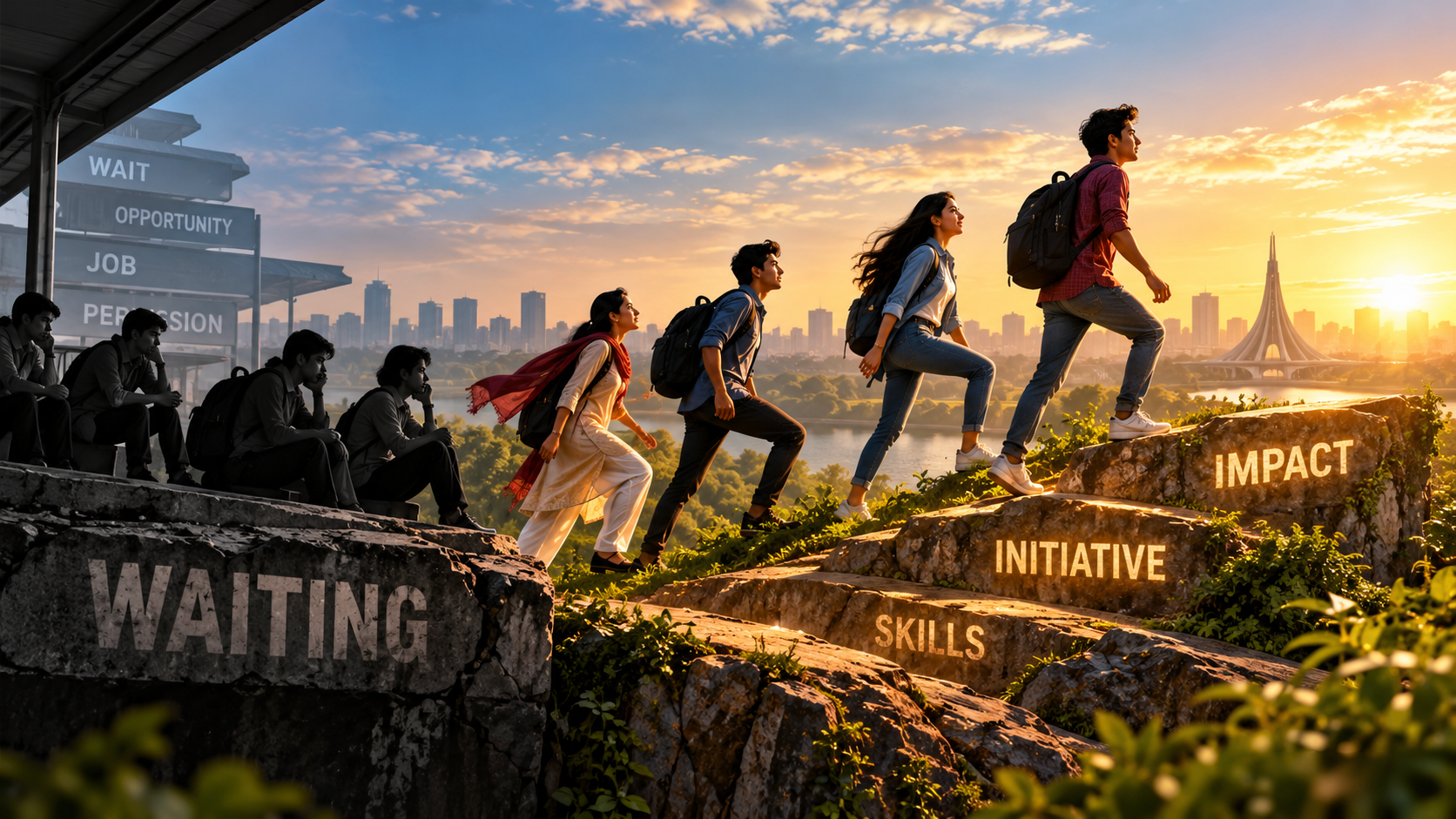
This is the first piece in a new Operator's Edge series on the politics and economics of South Asia. The question it opens with is simple: what does a country owe its young, and what happens when they conclude the answer is “nothing”? Between 2022 and 2026 the subcontinent has run an unplanned experiment. The same ingredients (a large young population, thin jobs, borrowed money, institutions that stopped answering to the people they served) produced five different outcomes. Some are recoveries. Some are warnings. One is still being written this week.
The Same Weather System
Before the five stories, the shared sky above them.
The oil and gas shock of 2026. On 28 February 2026 a US–Israeli strike on Iran began a war; in early March Iran closed the Strait of Hormuz, through which roughly a fifth of the world's seaborne crude and LNG normally passes. Brent crude rose from about $72 to over $118 by the end of March. Asian LNG spot prices more than doubled. Pakistan moved to a four-day public work week; Bangladesh closed universities and rationed fuel in March; the IMF's October forecasts for the region cite the war repeatedly. Nobody in South Asia caused this. Every one of these countries pays for it.
The young majority. Each country in this edition has a population whose median citizen was a child when its current political class took shape. Many are educated, online, underemployed, and unwilling to wait for the system to fix itself.
The credibility gap. In every case below, the trigger for mass action was not a single bad policy. It was the feeling that the people running the system were exempt from its rules: the rich children of Kathmandu's officials, the quota system of Dhaka, the president's circle in Colombo, a leaked exam in Delhi.
Sri Lanka — The Crash, and the Climb

How it fell. Sri Lanka's collapse was the first domino. Deep tax cuts in 2019 cut government revenue while spending continued; the Central Bank financed the gap by printing money; the 2019 Easter Sunday bombings and then COVID emptied the tourism sector (from about 5.6% of GDP in 2018 to under 1% in 2020); and a 2021 overnight ban on chemical fertilizer cut rice output by roughly a fifth within six months. Foreign debt had climbed past $56 billion. By March 2022 reserves were about $1.9 billion against roughly $4 billion of payments due that year.
In April 2022 Sri Lanka declared it would default on about $51 billion of external debt, its first sovereign default. Inflation passed 60 percent. People queued for days for fuel and cooking gas (about 15 deaths were reported among those waiting), power cuts reached 15 hours a day in April, and hospitals ran out of medicines.
The Aragalaya. "The struggle" began as a spontaneous citizens' protest in March 2022. Prime Minister Mahinda Rajapaksa resigned in May. On 9 July protesters entered the presidential residence, and President Gotabaya Rajapaksa agreed to resign, effective 13 July. It was a largely leaderless, citizen-driven movement that removed a head of state, a template the Bangladeshis and Nepalis would later follow in their own ways.
How it climbed out. Ranil Wickremesinghe, as president, took the unpopular road: a $3 billion IMF Extended Fund Facility in March 2023, VAT raised from 8% to 18%, income tax rates raised, and a debt restructuring that was finalised in December 2024 (including a Japan-led agreement spreading repayments over 2028–2042 and a separate restructuring of about $4.2 billion owed to China). The pain was real: unemployment rose and incomes were squeezed. But inflation fell to about –2% by December 2024.
Politically, voters then did something the neighbouring countries have not yet managed: they replaced the old establishment through the ballot. Anura Kumara Dissanayake and the National People's Power won the presidency in September 2024 and a large parliamentary majority that November, on an anti-corruption platform, and kept the IMF programme.
Where it stands (October 2026). The IMF reached staff-level agreement on its seventh review on 4 October 2026. Economic activity grew 4.2% in the second quarter, the eleventh consecutive quarter of growth. Gross reserves were $6.9 billion at end-August. Banks are described as well capitalised. Debt restructuring is "largely complete." Inflation, however, has returned to 8% (September), and the IMF warns about the war's energy effects, El Niño, and the pace of recovery from Cyclone Ditwah (November 2025), which the World Bank put at about $4.1 billion in direct damage (roughly 4% of GDP), with nearly two million people affected across all 25 districts.
The lesson. Sri Lanka shows that a collapse can be survived when (a) a government is willing to do something unpopular and (b) the political order is later renewed by election, not by force. It also shows the bill: the recovery took raised taxes, lost purchasing power, and a government willing to absorb voters' anger for two years. And the risk is not over, because the cyclone and the oil shock hit a country with little buffer.
Faith and culture. Sri Lanka's politics for decades ran through Sinhala-Buddhist majoritarianism and the unresolved Tamil question after the civil war ended in 2009; the Easter bombings added a new fracture with the Christian and Muslim minorities. The NPP's cross-communal, anti-corruption framing is a significant break with that pattern, though whether it resolves the underlying grievances (northern land, accountability for the war, minority security) is still an open test.
Pakistan — The General's Constitution

The long pattern. Pakistan has spent roughly half its life under direct military rule (Ayub 1958, Zia 1977, Musharraf 1999) and most of the rest under what scholars call "hybrid" arrangements, in which elected governments govern within limits set by the army. The country has never had a prime minister complete a full term.
Imran Khan: rise. Khan, a World Cup–winning captain turned anti-corruption politician, became prime minister on 17 August 2018, widely reported to have been helped to power by the military establishment. His government inherited a balance-of-payments crisis and a public debt of about Rs 30 trillion, turned to the IMF for a roughly $6 billion programme, and presided over a rupee that lost about 30% of its value in his first three years and inflation of 12.3% by December 2021.
Imran Khan: fall. On 10 April 2022 he became the first Pakistani prime minister removed by a no-confidence vote. Khan blamed a US conspiracy (Pakistan's National Security Council found no evidence of one), then turned his anger on the army itself. After his arrest and the violent protests of 9 May 2023, he was jailed in August 2023, where he remains. In the February 2024 election, candidates backed by his PTI took the largest bloc of seats, yet a PML-N–PPP coalition formed the government, a result his party and many observers contested.
The army's constitution. What followed was the consolidation of the military's position through the law itself:
- A contested 26th Amendment (late 2024) reshaped the judiciary's appointments.
- After the May 2025 conflict with India, the army chief Asim Munir was elevated to Field Marshal.
- The 27th Amendment (passed in November 2025, within days of being introduced) created a Chief of Defence Forces post, held by the army chief, placing him above the air and naval chiefs and giving him command of the body that manages Pakistan's nuclear arsenal; extended his tenure to 2030; gave the Field Marshal rank holder lifetime immunity from prosecution; and created a Federal Constitutional Court with power to override the Supreme Court, whose composition the executive largely shapes. Two senior Supreme Court judges resigned in protest. Chatham House's Farzana Shaikh called it a step "closer to authoritarian rule."
- Khan was sentenced to 14 years in the £190 million case (January 2025) and, with his wife, to a further 17 years in the Toshakhana-2 case on 20 December 2025, to run consecutively according to the information minister.
This week. The PTI planned a march on Islamabad to demand Khan's release (first set for 27 September, postponed to 4 October to allow talks). On 11 October the government declared an emergency in Khyber Pakhtunkhwa, the province the PTI governs, effectively suspending its elected government, citing its "deliberate disengagement from the fight against terrorism." The provincial chief minister, Sohail Afridi, was reportedly arrested. The PTI called it "a coup disguised as emergency." The governor will run the province for an initial six months.
The economy. The IMF projects Pakistan's growth at 3.5% and inflation at 9.9% for FY2026–27. The war's energy shock forced emergency austerity. The country is stable on paper, with an IMF programme and a government that follows its prescriptions, and fragile in practice: militancy has risen sharply in Khyber Pakhtunkhwa and Balochistan, and the political order that is supposed to resolve those problems has been narrowed to one man's chain of command.
The lesson. Pakistan is the counter-example in this edition: a society that did not get a Colombo or a Dhaka moment, or whose version of it was contained. Order is being bought with institutions: courts, provincial self-government, and a mainstream opposition leader. Economies can function this way for a long time; the cost is paid later, in legitimacy, which is exactly the commodity the region's young have shown they will not tolerate losing.
Faith and culture. Pakistan's founding idea as a homeland for South Asian Muslims has long been used by every power centre, military and civilian, to define who counts as a loyal citizen. The army presents itself as the guardian of the state's ideology and security; the PTI mobilises Islamic and nationalist language too. The religious question is therefore not whether Islam shapes politics (it does, on all sides) but who has the authority to speak for it.
Bangladesh — The Revolution After the Revolution

July 2024. What began as a student protest against the government-job quota system turned, after a lethal crackdown, into a national uprising. UN investigators put the number of civilians killed at up to 1,400. Sheikh Hasina fled to India on 5 August 2024 after fifteen years in office. Muhammad Yunus led an interim government from 8 August.
Accountability. In May 2025 the interim government banned the Awami League's activities under the Anti-Terrorism Act pending trial. On 17 November 2025 the International Crimes Tribunal sentenced Hasina to death in absentia for crimes against humanity; further sentences followed in corruption cases (21 years in total in the Purbachal plot cases reported in November 2025; further sentences in February 2026). India, where she lives, has not extradited her, and the question sits at the centre of the Dhaka–Delhi relationship.
The election. On 12 February 2026, with the Awami League barred, Bangladesh held its first national election since the uprising, alongside a referendum on the "July Charter" of reforms. The BNP won 209 of 300 seats (about 50% of the vote); Jamaat-e-Islami came second with 68 seats (about 32%), its strongest result ever; the student-born National Citizen Party won 6. Turnout was about 59%, up about 17 points. A majority voted yes in the referendum. Tarique Rahman was sworn in as prime minister on 17 February. Polling concluded without major disruption, according to the Election Commission.
What the new government faces. The students won the revolution and, in electoral terms, lost the election: the party they founded took 6 seats, while an older party and a better-organised Islamist party took the rest. The agenda they raised (end of dynastic politics, accountable policing, an independent judiciary, a neutral election system) now depends on a government that is itself a party with a long history in power.
The July Charter: a major failure, and a betrayal of the mandate. The most serious failure of the new government so far is not economic. The BNP has refused to implement key articles of the July Charter, the reform settlement that the BNP itself signed in 2025 and that voters endorsed by a majority in the referendum held alongside the election. The Charter contains dozens of proposals, 48 of them requiring constitutional amendment, among them limits on the prime minister's tenure, safeguards for judicial and Election Commission independence, and a 100-member upper house. When the new parliament opened in March, BNP members took only the parliamentary oath and declined the separate oath as members of the Constitution Reform Council that the Charter's implementation order envisaged. Opposition members from Jamaat and the NCP took both. The council, as one report put it, exists only on paper. The BNP's stated reasoning is legal: the constitution recognises no such body, and Parliament can amend it under Article 142 with a two-thirds majority; its Home Minister, Salahuddin Ahmed, who negotiated the Charter for the party, has reportedly called the implementation order "illegal." In September the government set up a parliamentary committee to deliver Charter amendments by the end of 2026; Jamaat's alliance and the NCP boycotted it, arguing that it bypasses the referendum-endorsed process. Whatever the legal argument, the effect is plain. A party that signed the Charter, and then won power on the back of the movement that produced it, has declined to be bound by it. For the young people who bled for these reforms, it is a blatant refusal of the popular mandate and an utter betrayal of the promise of July. It is also the clearest test of the question this edition keeps returning to: whether a government that came to power on a wave of public trust will submit to the checks that wave demanded.
The economy is the harder test.
- The IMF cut its FY2026–27 growth forecast to 3.2% (from 4.3%) and projects inflation of 10.9%.
- Non-performing loans are reported to have reached about 33% against a 10% target set in the 2023 IMF programme.
- Revenue is about 7% of GDP, among the lowest in the world, according to the IMF.
- Bangladesh exited the previous IMF programme in May 2026 after drawing $3.8 billion of $5.5 billion, and is now negotiating a new $4.5 billion package, hoping for a staff-level agreement by the end of 2026, with subsidies (electricity, fertiliser) the most contested item.
- The Iran-war fuel squeeze in March hit a country that imports most of its LNG and petroleum.
Faith and culture. The uprising reopened Bangladesh's oldest argument, between a Bengali-secular identity (1971) and an Islamic one. Jamaat's 68 seats make it the principal opposition and a force on every contested question: education, women's roles, the place of the Awami League's secular legacy.
The lesson. Dhaka's story is the hardest to read: a successful revolution is not the same as a settled state. The test of 2026–27 is whether the new government can do three things the old one could not: share power, accept scrutiny, and fix the banks and the budget at the same time. On the first two, its refusal to implement the July Charter is a failure that no economic recovery can paper over.
Nepal — The Republic of the Young, and the Mountain That Moved

September 2025. In early September the government banned 26 social-media platforms. Within days, young protesters, many carrying the "One Piece" pirate flag and targeting the lifestyles of politicians' children (the "nepo kids"), filled Kathmandu. Police fired live rounds; about 76 people were killed. Protesters set fire to parliament and government buildings. Prime Minister K. P. Sharma Oli resigned on 9 September, and within a week the former Chief Justice Sushila Karki became interim prime minister.
The election. In early March 2026 Nepal held its first post-protest election. The Rastriya Swatantra Party won more than two-thirds of the 165 directly elected seats, wiping out much of the Nepali Congress and the CPN-UML, the parties that had rotated power since the monarchy fell in 2008. Balendra "Balen" Shah, 35, a rapper and former Kathmandu mayor, became the youngest prime minister in the country's history.
Six months in. Accounts are mixed:
- Oli and a former home minister were arrested in March over the crackdown; the Supreme Court ordered their release in April; they remain under investigation but have not been charged.
- In May the government invited Gen Z activists to advise on constitutional amendments; 25 of 29 invited boycotted, saying earlier agreements were being ignored. An activist estimates over 900 protesters are officially jailed on arson charges.
- Critics, including a commentator in The Himalayan Times (an opinion piece, not a news report), say Shah has centralised decision-making, personally holding several ministries and bypassing others; that an abrupt order to move dormant bank funds into the treasury unsettled the banks and stalled large loans; and that the government has not yet visited India or China. Supporters say he has shown the energy and zero-tolerance for corruption his voters wanted.
- A Gen Z demands review a year on concluded they were met "partly": the old guard is gone and elections were held, but corruption has barely been addressed and structural reform has not meaningfully started.
The mountain that moved. On 26 August 2026 a glacial collapse sent a torrent of mud, rock and water down northern Nepal and across the China–Tibet border. The National Disaster Risk Reduction and Management Authority reports at least 1,453 dead and about 5,500 missing, with nearly 14,000 rescued. The government's preliminary estimate of the damage is $5 billion. About 99% of Nepal's electricity comes from hydropower, so every damaged valley is also an infrastructure and energy question. World Weather Attribution described it as a "compound crisis" of warming, glacier retreat, permafrost thaw and unstable slopes, not a single freak event.
The way out. At the UN General Assembly on 24 September, Shah called the flood "a warning to the world," noted that Nepal emits less than a tenth of one percent of the world's greenhouse gases, applied for $20 million from the UN loss-and-damage fund (which has made no payment yet), and proposed a Himalaya Climate Resilience Mechanism with India and China to share satellite data and monitor glacial lakes. The idea is sound: glaciers do not respect borders, and neither does the water they release. Whether Kathmandu, Delhi and Beijing can cooperate is the real test.
Faith and culture. Nepal moved from a Hindu kingdom to a secular federal republic in 2008, and a loud minority has campaigned since for the monarchy and the Hindu state to return. The Gen Z movement was not a religious one; it was against inherited privilege of every sort.
The lesson. Nepal combines the most radical political change in the region (a generation voting itself into power) with the most acute physical vulnerability. Its young leaders have a mandate; what they lack is institutional depth: the civil service, the coalition partners and the time to turn a mandate into delivery.
India — The Protest in the World's Largest Democracy

India's story is unfinished, and unlike its neighbours' it is happening in a country with a growing economy (forecasts of 6.5–7.5% growth), a functioning if strained court system, and an elected government in its third term, not a collapsing one.
The spark: an exam. In June 2026 a leak in the national medical entrance exam (NEET) became a symbol of what many young Indians describe as a rigged ladder: huge competition, few jobs, and tests that can be bought. Mass protests followed, and the Education Minister, Dharmendra Pradhan, resigned on 25 July 2026.
The joke that became a movement. On 15 May 2026, during a Supreme Court hearing, Chief Justice Surya Kant compared certain unemployed youths and social-media activists to "cockroaches" (he later said he had been misquoted and meant people with fake degrees). The next day, Abhijeet Dipke, a political strategist, launched the Cockroach Janta Party online as a satire: "the Voice of the Lazy & Unemployed", a "secular, socialist, democratic, and lazy" youth front. It passed 15 million Instagram followers within a week. The government ordered its X account withheld in India on 21 May; the Delhi High Court ordered it restored on 7 July. Its manifesto includes barring retired chief justices from Rajya Sabha seats and holding election officials criminally accountable for wrongful deletions. The Election Commission has not registered it as a party. Backers include opposition parties, student groups, and figures such as Anna Hazare and Sonam Wangchuk.
The core grievance: the voter rolls. The Election Commission of India (ECI) has run a Special Intensive Revision (SIR) of the electoral rolls, the ninth such exercise, announced in October 2025, in which voters must prove their eligibility with documents. Media reports put the number of names removed at about 130 million (the figure Al Jazeera cites is "more than 133 million"); one summary breaks it down as roughly 95 million "absent, shifted or others," 27 million deceased and 10 million duplicates. The ECI says it is removing duplicate, dead and fraudulent entries. Critics say the process is opaque, burdens the poor and the migrant, and disproportionately affected Muslims, and that it benefits the ruling BJP. These claims are contested and the figures are not fully reconciled (West Bengal's numbers, for example, differ across reports).
On 23 September 2026 The Indian Express reported that two of the three election commissioners had filed written objections 14 times in 10 months, alleging that the Chief Election Commissioner, Gyanesh Kumar, took decisions without them. The ECI replied that all key decisions were unanimous and the objections were "suggestions." On 5 October the Supreme Court declined to suspend Kumar but issued notice to the ECI.
This month. The Cockroach party set a deadline of 2 October (Gandhi Jayanti) for Kumar to resign. Protests have run almost daily; police detained thousands over the weekend of 10–11 October, and Reporters Without Borders says at least 16 journalists were detained covering them. A court ordered the release of the movement's leaders; its founder was reportedly detained again on 16 October ahead of a new rally. Rahul Gandhi petitioned the Supreme Court on 12 October. Prime Minister Modi, in office twelve years, has defended India as the "mother of democracy."
Faith and culture. India's polarising question runs through the voter-roll debate: citizenship, "illegal migrant" rhetoric aimed largely at Bengali-speaking Muslims, and the Hindutva-versus-secular argument over what India is. The protests' leadership, notably, is deliberately cross-cutting, "secular, socialist, democratic, and lazy", and led by a satirist, not a religious or party figure.
When Trust Breaks: India's Institutions

This is the section the rest of the edition has been building to. A democracy is not only elections; it is a set of institutions, each of which asks citizens to accept an outcome they did not choose. That acceptance, "the loser's consent," only holds if people trust the referee.
A democracy is not only elections; it is a set of institutions, each of which asks citizens to accept an outcome they did not choose.
What the record shows (and what it doesn't). What follows distinguishes facts from allegations.
- The election referee. In 2023 Parliament passed a law replacing the Chief Justice on the panel that appoints election commissioners with a Union minister, giving the government a majority. Gyanesh Kumar and Sukhbir Sandhu were appointed in 2024 over the then opposition representative's objection (who said the shortlist reached him minutes before the meeting). The same law gives election commissioners strong legal immunity, which the Supreme Court is now examining. A January 2026 petition challenges it. Surveys by Lokniti-CSDS found trust in the ECI falling around the 2024 election (though it remained among the most-trusted institutions in the same survey). Whether SIR was administered fairly is exactly what the Supreme Court has now been asked to decide.
- The courts. The Supreme Court has intervened in SIR before (reportedly restoring some 1.6 million West Bengal voters) and refused on 5 October to suspend the Chief Election Commissioner. But the Chief Justice's "cockroach" remark, whatever he meant, became the name of the movement itself, an unusual moment for a judiciary that depends on public respect for its authority.
- The exam system. The NEET leak cost a Union minister his job. For young Indians, the central institution is not a ministry but the exam: the ladder out.
- The press and the rankings. India fell to 157th of 180 in the 2026 World Press Freedom Index (RSF, via Scroll), and the V-Dem Institute's 2026 report reportedly rated India's electoral-democracy score at its lowest since 1975, ranking it 106th (via Outlook India). Indian officials reject these indices as biased; they are, in any case, what investors, diplomats and the diaspora read.
- The policing of dissent. Mass detentions of protesters and of journalists with press cards are documented by RSF and by Al Jazeera's reporting.
Why trust matters economically, not just morally. India is the anchor for the region's growth; its credibility affects its neighbours' costs of capital, transit and trade.
- Capital: investors price political predictability. A dispute over the integrity of the electoral roll is a governance risk that sovereign ratings and long-term investors notice.
- Compliance: when people stop believing the rules apply equally, tax compliance, contract enforcement and public-health messaging all get more expensive.
- Talent: the young people now protesting are the same ones who might otherwise start companies; trust shapes whether they stay.
Why it matters to the region.
- India is the biggest trading partner, electricity market, remittance destination (for Nepal) and transit route for all of its neighbours. A politically distracted or polarised India is a less reliable neighbour.
- Both Bangladesh and India are re-negotiating how they see each other. Hasina's presence in India, the "illegal migrant" language of the voter-roll debate, and the Ganges Water Treaty (signed for 30 years in December 1996, so due to expire this December) are all live issues.
- A loss of faith in elections in the region's largest democracy weakens the argument that elections are the best route to change, an argument Sri Lanka's voters just vindicated and Pakistan's have been denied.
A reading, not a prediction. India differs from its neighbours in ways that matter: a far bigger and more diversified economy, a federal system in which many states are run by opposition parties, a coalition-dependent government at the centre, a military that stays out of politics, and a court system that, while criticised, still hears cases against the executive. On the other side of the ledger is something its neighbours' revolutions had too: a generation that no longer believes the referee is neutral. The question is whether Indian institutions can be repaired from within (by the Supreme Court's ruling, by parliamentary reform of the 2023 Act, by an ECI that voluntarily opens its process to independent audit) before the distrust hardens into something a satirical party can no longer channel.
Five Journeys, Side by Side
| Sri Lanka | Pakistan | Bangladesh | Nepal | India | |
|---|---|---|---|---|---|
| Trigger | Default, shortages (2022) | Ouster of a popular PM (2022), then jailing | Quota protest turned into uprising (2024) | Social-media ban and elite privilege (2025) | Exam leak, voter-roll revision (2026) |
| How it ended / ends | President fled; IMF deal; elections | Army-led hybrid order; constitution rewritten | Interim government, then election | Interim PM, then election | Ongoing |
| Who holds power now | NPP (Dissanayake) | Civil-military hybrid; Field Marshal Munir | BNP (Tarique Rahman) | RSP (Balen Shah) | BJP-led NDA (Modi) |
| Economy (latest) | Q2 growth 4.2%; inflation 8%; reserves $6.9bn | FY27 growth 3.5% (IMF); inflation 9.9% | FY27 growth 3.2% (IMF); inflation 10.9%; NPLs ~33% | Flood damage est. $5bn; 99% hydropower | Growth ~6.5–7.5%; youth jobs crisis |
| Violence | Low | Rising militancy; arrests | ~1,400 killed (UN) in 2024 | ~76 killed (2025) | Thousands detained, in recent weeks |
| Faith/identity fault line | Sinhala-Buddhist majoritarianism, Tamil question | State ideology, army as guardian | Secular vs Islamic identity; Jamaat's rise | Hindu kingdom → secular republic | Hindutva vs secular; Muslims and SIR |
| Biggest unanswered question | Can recovery survive new shocks? | What happens when legitimacy runs out? | Will the government honour the July Charter? | Can mandate become delivery? | Can institutions be repaired? |
Three Patterns Worth Naming
One
Economic pain was the accelerant; institutional insult was the match.
Fuel queues in Colombo, a fertiliser shortage, a social-media ban, an exam leak, none alone toppled anyone. Each landed on a population already convinced that those in power were exempt from the rules.
Two
Removing a government is easier than building a state.
Colombo needed an IMF programme and a painful two years. Dhaka and Kathmandu now face the same question after the cheering: banks, revenue, a civil service that actually delivers. In Dhaka there is a second test as well: whether the winners will keep the promises they signed, starting with the July Charter.
Three
The countries that avoided collapse paid with legitimacy instead.
Pakistan's order and India's growth are real. So is the quiet cost of narrowing who can say no.
What This Means for Bangladesh, for Business, and for the Young
For Bangladesh. The IMF numbers above (3.2% growth, 10.9% inflation, 33% bad loans, 7% revenue-to-GDP) are not a verdict on the revolution. They are the ledger of what the revolution inherited. The realistic path, as Sri Lanka showed, is unglamorous: a credible IMF programme, a revenue base broader than the few who already pay, bank resolution that is honest about losses, and a government that accepts being checked, which begins with honouring the July Charter it signed. Sri Lanka also shows the reward: three years later, growth, banks that profit, and a political order that got renewed by voters instead of by force.
For a business owner. Treat political risk as a balance-sheet item: fuel and LNG exposure, import-dependence, Gulf-remittance sensitivity of your customers' incomes, and the credit environment while bad loans are cleaned. The firms that handled 2022–26 best were those with low debt and honest books, which is the same discipline we apply inside any well-run company.
For a young person. The pattern across five countries is that unorganised anger can topple a government and cannot run one. Nepal's Gen Z won an election; Bangladesh's students won a revolution and lost one; India's satirists have not decided whether to become a party. The durable form of youth power looks like what Sri Lanka's voters did in 2024: organise, vote, then hold the winners to their promises.
Conclusion — The Operator's Take
Every story in this edition comes back to one idea: trust is the asset beneath every other asset, and it is kept or lost in small, ordinary acts of honesty long before it is lost in public. Sri Lanka lost the trust of its people and rebuilt it, slowly, by doing hard things in the open. Bangladesh and Nepal are in the middle of that rebuilding. Pakistan has chosen order over consent and is learning what it costs. India, the largest of them, is being asked by its own young whether its referees still deserve to be believed.
None of this is fated. A people's condition changes when the people change, and in this decade the ones doing the changing have been the young. They have already shown what they can pull down. The next five years will show what they can build. That is a hopeful thing to be able to say about a region so often described by its problems: its young are no longer waiting, and the work now is to turn that impatience into institutions that last.
— Mustafizur Rahman Shazid
CEO · Board Director · Strategic Advisor
Houston, Texas · Dhaka, Bangladesh
A question for you: in your own workplace, your own community, or your own family, where is the institution you are quietly most worried about losing trust in, and what is one thing you could do this month to make it more deserving of it? I welcome the conversation.