

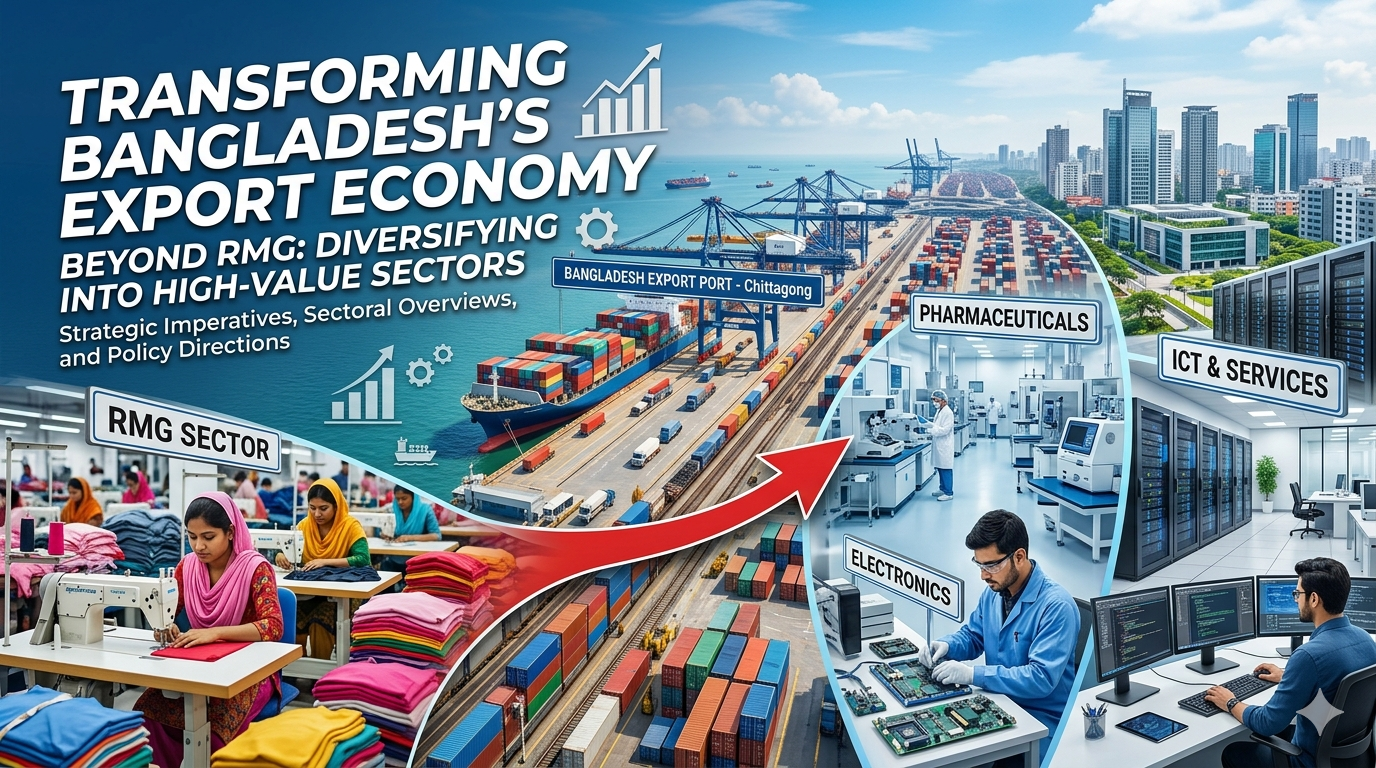
Bangladesh built the second-largest garment export industry on earth starting from almost nothing in the 1980s. That achievement is not luck — it is a proof of concept. The question now is whether Bangladesh can replicate that strategic intentionality in new sectors before the window closes.
The window is not a metaphor. It has a date on it: November 2026, when Bangladesh graduates from Least Developed Country status and loses the trade preferences that have underpinned roughly 70% of its global exports. The U.S. tariff shock of 2025 — 37% on garments, later reduced to 20% — was a preview of the permanent exposure ahead. The diversification conversation Bangladesh has been having for twenty years must now become an execution plan.
This article does not argue that Bangladesh should abandon the RMG sector. There is nothing inherently wrong with garments being the cornerstone of the economy — its extraordinary growth over the last three decades lifted millions out of poverty and propelled Bangladesh from an impoverished state to middle-income status. The garment industry should be defended, upgraded, and grown. But the country cannot build its next fifty years on a single needle and a single thread.
What follows is a structured analysis of five sectors where Bangladesh's existing competencies give it a genuine — not theoretical — advantage; a comparative study of how South Korea and Malaysia made similar transitions; and a sector-by-sector action plan with specific timelines, process owners, and success metrics.
The Diversification Gap: Why It Has Not Happened Yet
Bangladesh has been talking about export diversification since the 1990s. The 6th, 7th, and 8th Five-Year Plans all included it as a priority. The Perspective Plan 2041 features it prominently. Yet the numbers tell a stubborn story.
Why has diversification stalled despite thirty years of policy intent? Three structural causes stand out, and they are worth naming plainly before prescribing solutions.
First, the RMG sector is extraordinarily good at absorbing policy attention. When garments sneeze — a factory fire, an order cancellation, a tariff threat — the entire government apparatus responds. No other sector commands that institutional attention or that density of lobbying capacity. Other sectors die quietly by comparison.
Second, there is a policy-induced anti-export bias. Domestic manufacturers enjoy government-imposed protectionism through higher import duties, which diminishes the competitiveness of local industries against foreign products. Due to the domestic market's convenience, manufacturers are often disincentivised to export — they avoid the compliance and standards required for the global market.
Third, and most importantly, there has been no dedicated institutional home for diversification. Export promotion has been fragmented across the Export Promotion Bureau, BIDA, line ministries, and trade associations — none of whom owns the outcome. Responsibility that is shared by everyone belongs to no one.
Five Sectors Built on Bangladesh's Core Competencies
The mistake most diversification strategies make is to chase sectors that sound impressive rather than sectors that build on what already exists. Bangladesh does not need to become a semiconductor fabrication hub overnight. It needs to identify where its actual competitive assets — a large, cost-effective workforce; proven manufacturing infrastructure; a growing domestic market; diaspora networks; and a pharmaceutical tradition — can be translated into global competitiveness within a five-to-ten year horizon.
These five sectors meet that test.
Pharmaceuticals & Biotech
Current exports: $213M FY25 → Target: $1B by 2030Bangladesh's pharmaceutical exports have more than doubled over seven years, reaching $213 million in FY2024–25. Bangladeshi firms now export to 166 nations across the globe. This industry has remained largely overshadowed by RMG in public rhetoric but is perhaps second to none in terms of its promise — Bangladesh is the only LDC with a well-developed pharma industry, already meeting 97% of domestic demand and exporting to over 150 countries. The core competency is proven. What is missing is API self-sufficiency and regulatory compliance for high-value markets.
IT / ITES & Digital Services
Current exports: ~$700M → Target: $5B by 2031Bangladesh has over 650,000 freelance ICT professionals and thousands of new ICT graduates annually, making it one of the top providers of online talent globally. Yet this is only a fraction of its full potential — software development, cloud services, AI services, and BPO represent new frontiers for global export. The workforce exists. The infrastructure and the institutional pipeline to turn it into an organised export industry do not yet exist at scale.
Leather, Footwear & Goods
Current exports: $1.06B FY25 → Target: $3B by 2030Leather and leather goods is the second highest export-earning sector in Bangladesh. Leather footwear exports rose 26.08% during the first ten months of FY25. The sector holds considerable potential, yet its growth is constrained by failure to ensure environmental compliance, such as obtaining Leather Working Group (LWG) certification. The core manufacturing competency is real. The compliance gap is fixable — and fixing it unlocks EU and US premium markets immediately.
Light Engineering & Electronics Assembly
Current exports: ~$600M → Target: $2B by 2030Export growth in targeted non-RMG sectors — including light engineering, footwear, and plastics — increased by nearly 83% annually from 2016 to 2023, far exceeding the initial 30% target, creating nearly 180,000 new jobs. The World Bank has identified light engineering as one of four critical sectors for Bangladesh's export diversification, alongside leather, footwear, and plastics. Bangladesh has existing metalworking capacity, auto-parts manufacturing seeds, and a workforce with demonstrated precision skills.
Agro-Processing & Halal Food
Current exports: ~$800M → Target: $3B by 2031Agro-processing acts as a connecting link between local farmers and global supply chains — shrimp, processed fruits, spices, juice, ready-to-eat products, and halal products find substantial markets abroad. However, inconsistencies in supply chains, insufficient cold storage, and fragmented food safety certification limit participation in higher-value markets. The halal food angle is particularly strategic — a $2.5 trillion global market where Bangladesh's Muslim-majority demographic is an authentic brand asset.
Shipbuilding & Marine Engineering
Current exports: ~$50M → Target: $500M by 2032Bangladesh already has a small but growing inland and coastal vessel-building industry, with firms like Ananda Shipyard exporting to European buyers. The workforce has metal-fabrication skills directly transferable from light engineering. The model here — building from steel fabrication and cheap skilled labour toward higher-value vessels — mirrors exactly how South Korea's Hyundai Heavy Industries began in the 1970s. The opportunity is structural, not speculative.
Lessons from Those Who Did It: South Korea and Malaysia
Bangladesh does not need to invent a diversification playbook. Two countries in Asia — starting from positions of comparable or lower development — made exactly the transition Bangladesh must now make. Their experiences contain specific, actionable lessons. They also contain warnings that are easy to miss in the celebratory retelling.
From Garments to Shipbuilding to Samsung: A 20-Year Structural Break
Korea's manufacturing in the 1960s revolved around light, labour-intensive activities — garments, footwear, toys, food products, and light consumer electricals. The kind that were the norm in other low-income economies. But starting in the early 1970s, Korea initiated a structural break and launched its Heavy and Chemical Industry Promotion Plan (HCIPP) to diversify into more complex, technology-intensive products. It constructed a state-owned iron and steel complex at Pohang, a machinery production complex at Changwon, a petrochemical complex at Ulsan, an electronics complex at Gumi, and a major shipbuilding yard at Ulsan.
Korea's shipbuilding industry started with domestically produced steel, cheap local labour, and subsidised government loans. Design capabilities took longer to acquire — close to fifteen years. Korea's development trajectory is characterised by a shift from production-based diversification to technology-based diversification. While many developing countries remain captive to their natural endowments, Korea early on decided to produce new products that were distinct from its current production capabilities.
Key lesson for Bangladesh: Korea did not try to do everything at once. It selected six strategic industries, concentrated state support, set explicit export targets, and measured performance relentlessly. The long-run strategy favoured diversification into manufactured exports, and the state — given the initial weakness of the private sector — played a leading role in formulating and implementing trade and industrial policies, targeting a few sectors expected to perform well in international markets.
Building the Knowledge Infrastructure That Outlasts Any Single Government
The rapid increase in private sector R&D spending was promoted by the Korean government through direct and indirect policies. In the 1970s, the Korea Industrial Technology Association (KOITA) was formed to facilitate the establishment of private research centres. Manufacturing firms with annual revenues of over $25 million were encouraged to establish corporate research institutes, partly through tax exemptions on R&D expenses. The number of R&D centres in Korea increased from 567 in 1976 to 56,223 in 2020 — and R&D personnel grew from 11,661 to 558,045 over the same period.
Key lesson for Bangladesh: The diversification that produced Samsung and Hyundai was not the result of a single policy decision. It was the accumulation of thousands of research centres, skills programmes, and technology licensing deals over two decades. Bangladesh must start building that infrastructure today — even if the payoff is ten years away.
How One State Became the World's Semiconductor Hub in Fifteen Years
In the 1970s, under the Second Malaysia Plan, Malaysia established free trade zones to attract multinationals that were relocating low-wage electronics operations from more developed countries. In the 1970s, an initial wave of electronics multinationals setting up in Malaysia included Texas Instruments, Intel, Motorola, and Hewlett Packard. By 1980, 25 electronics factories operated in four free trade zones in Penang, and Malaysia was the world's largest exporter of semiconductors.
Malaysia established free trade zones, most notably the Penang Bayan Lepas industrial parks. Such incentives included income tax holidays for up to eight years under "pioneer" status, investment tax credits of up to 40%, and export incentives. The Penang Development Corporation established the state's first electronics company with two pioneering multinationals. By mid-1972, they were joined by Intel Corporation, Hewlett-Packard, Hitachi, Motorola, and others. Chief Minister Lim Chong Eu personally hosted foreign investors — it took great persuasion to convince them to come to a state they had largely never heard of.
Key lesson for Bangladesh: The Penang model was built on a specific geographic focus, personal political championship at the highest level, and a willingness to offer hard incentives. Bangladesh's EPZs exist — but they lack Penang's institutional champion and its culture of active investor cultivation rather than passive approval processing.
Start with Assembly, Build Toward Design: A 50-Year Patience
In the 1970s and 1980s, the focus of Malaysian policymakers with regard to the E&E industry was primarily on attracting FDI to create jobs. Beginning in the late 1980s, their focus gradually shifted toward the creation of linkages to maximise the benefits of existing FDI. A country's strategies and policies should always be based on its phase of development and the phase of development of the industry in question. Such a phased approach can help developing countries focus their resources on their most pressing needs while also keeping a long-term perspective.
The creation of the Penang Skills Development Centre in 1989 stands out as an internationally recognised example of a tripartite, industry-led workforce development initiative involving the private sector, government, and academia.
Key lesson for Bangladesh: Malaysia did not start by trying to design chips. It started by assembling them — and spent thirty years building the skills base to move up the value chain. Bangladesh's IT sector is at exactly that early stage. The temptation to skip steps must be resisted; the discipline to execute each phase properly must not.
| Indicator | Bangladesh 2026 | South Korea ~1972 | Malaysia ~1972 |
|---|---|---|---|
| Dominant export sector | RMG (~80% of exports) | Textiles, plywood, wigs (~65%) | Rubber & tin (~70%) |
| Labour cost advantage | Strong (among lowest in Asia) | Strong at launch | Strong at launch |
| Workforce size | ~70M working age | ~15M working age | ~6M working age |
| State industrial policy capacity | Moderate — fragmented | Strong — centralised EPB | Moderate — PDC model |
| Key institutional instrument | BIDA, EPB (underperforming) | Economic Planning Board (EPB) | Penang Dev. Corp. (PDC) |
| FDI openness | Growing — +20% FY25 | Selective — prioritised HCI | Open — free trade zones |
| Key risk | LDC graduation + US tariffs | Capital scarcity + Cold War | Ethnic economic imbalance |
The comparison reveals both the opportunity and the challenge. Bangladesh's workforce is far larger than either Korea or Malaysia had at the equivalent moment — which means the potential scale is greater. But Bangladesh's institutional capacity for strategic industrial policy is weaker than either of its comparators were. That gap is the primary thing that must be closed.