
What a Family Business Teaches You that a Public Company Never Can
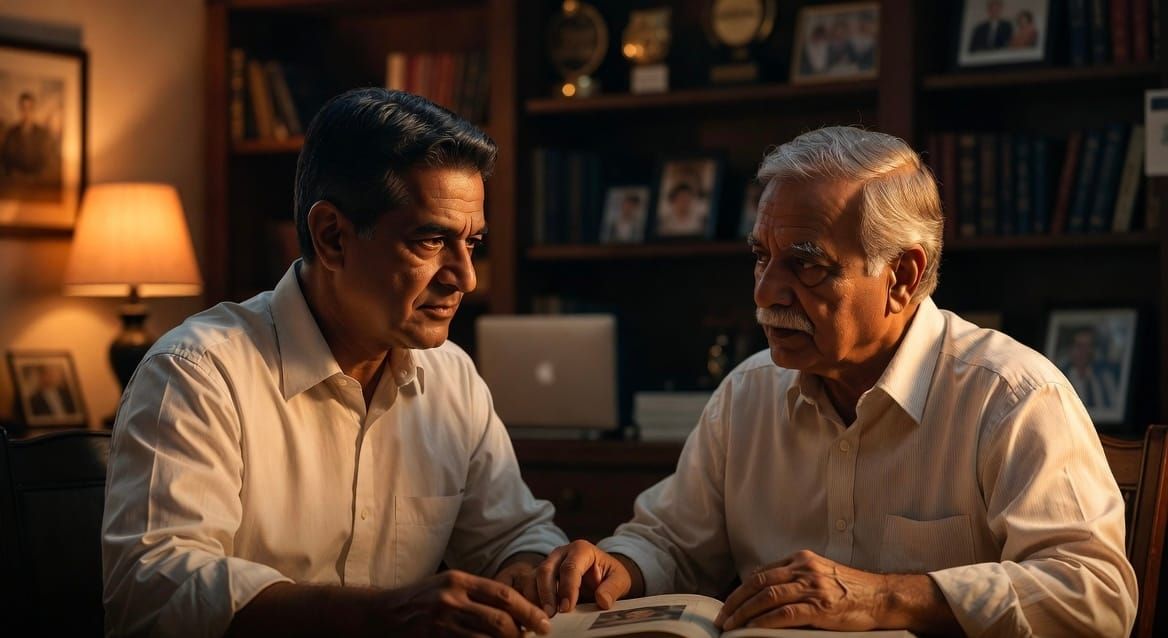
My father started this company in 1987. I joined it in 1995 instead of pursuing the American career I had planned. Thirty years later, I understand why that decision taught me things no business school, no corporate ladder, and no executive program could have.
In 1995, I graduated from IIT Madras with a degree in aerospace engineering and a plan. The plan involved the United States — further studies, a career built in one of the world's most competitive professional environments, the kind of trajectory that people from my background worked enormously hard to reach. I was twenty-one years old and I believed, with the confidence that only a twenty-one-year-old can sustain, that I knew exactly what I was going to do.
Then my father asked me to come home.
He had been building a consumer electronics business since 1987 — eight years of the particular kind of effort that first-generation entrepreneurs make, which is to say the kind that does not stop when the office closes and does not take weekends off. He did not demand that I join him. He asked. And I said yes, partly out of love and partly out of something I could not yet name — a pull toward something that felt more real than the plan I had made for myself.
Thirty years later, I understand what that something was. It was the chance to learn a version of leadership that is simply not available anywhere else.
Lesson One
You learn what it means to be truly accountable — because the consequences are personal.
In a public company, a bad quarter is a problem to be managed — with analysts, with the board, with carefully worded communications. The consequences are professional. In a family business, a bad quarter is felt at the dinner table. The people whose livelihoods depend on the decisions you make are not abstractions in a workforce planning model. They are people your father hired, people who have been with the business longer than you have, people whose children grew up knowing your name.
"Accountability in a family business is not a governance mechanism. It is a lived experience. You cannot outsource it, delegate it, or manage it through a communications strategy. It simply exists — every day, in every decision."
This is not comfortable. But it produces a quality of decision-making that I have rarely seen replicated in executives who have spent their entire careers in large corporate structures. When the consequences of your choices are personal, you think differently. You consider more carefully. You own the outcome in a way that no incentive structure can manufacture.
Lesson Two
You learn to build for a time horizon that most executives never consider.
The question I asked myself at every major decision was not "what does this do for this year's results?" It was "what does this do to the business my father built — and what does it leave for whoever comes after me?" That is a fundamentally different frame. It lengthens your thinking in ways that quarterly reporting cycles actively discourage.
When I initiated our SAP ERP implementation as COO, the payback period was longer than most corporate approval processes would have tolerated. When I pushed for our AI transformation as CEO — building a data lake, integrating demand forecasting, deploying Salesforce and Microsoft Copilot — the immediate ROI was not the argument I made to myself. The argument I made was about what kind of business we needed to be in ten years. A family business gives you the freedom to make that argument and the responsibility to get it right.
Lesson Three
You learn that leadership and stewardship are not the same thing — and that the best leaders understand both.
Leadership, as it is typically taught and practiced, is about direction — setting strategy, allocating resources, making decisions, driving outcomes. Stewardship is something quieter and harder. It is about preserving what has value, protecting what took decades to build, and resisting the temptation to optimise for the present at the expense of the future.
My father did not hand me a business. He handed me a responsibility. The 1,500 people who worked in that organization were not my workforce — they were the cumulative result of his thirty-eight years of decisions, relationships, and trust. I was accountable to that history in a way no external CEO appointment could replicate. It shaped everything about how I led — how I handled difficult decisions, how I thought about culture, how I measured success.
"The best leaders I have encountered — in any context — carry something of the steward in them. They understand that they are custodians of something larger than their own tenure, and they lead accordingly."
Lesson Four
You learn to read people with a depth that formal structures rarely require.
In a family business, you cannot hide behind hierarchy. The managing director's son does not automatically command respect — he earns it, or he does not have it. I spent years in roles below my eventual title, learning from people who had been with the business since before I arrived, absorbing the institutional knowledge that no induction program can transfer. I learned to read people not through performance reviews and competency frameworks, but through the daily reality of working alongside them across every function of the business.
That education in human judgment — in understanding who can be trusted with what, in knowing the difference between someone who performs in a review and someone who holds the operation together at 11pm when something goes wrong — is one of the most valuable things I carry. It is not listed on a resume. But it informs every leadership decision I make.
What I Would Say to the Twenty-One-Year-Old With a Plan
I did not pursue the American career I had planned in 1995. I pursued something harder, less legible, and — I now understand — far more formative. The plan I abandoned gave way to an education in leadership that I could not have designed or anticipated: in accountability, in long-horizon thinking, in stewardship, and in the kind of human judgment that only comes from years of genuine responsibility.
I am in Houston now, thirty years later, bringing that education to a new market and a new chapter. What I carry from my father's business — from the decision to come home when I was twenty-one — is not a credential. It is a way of leading. And I would not trade it for the plan I gave up.
A question for you: For those of you who have led or grown up in a family business — what did it teach you that your corporate career could not have? And for those who have not — what do you think you missed? I am genuinely curious about both answers.
If this resonated, I would be glad if you shared it with someone navigating the particular complexity of leading a business built by someone they love. It is a kind of leadership that deserves more honest conversation than it usually gets.
— Mustafizur Rahman Shazid
CEO · Board Director · Strategic Advisor
Houston, Texas · Dhaka, Bangladesh