

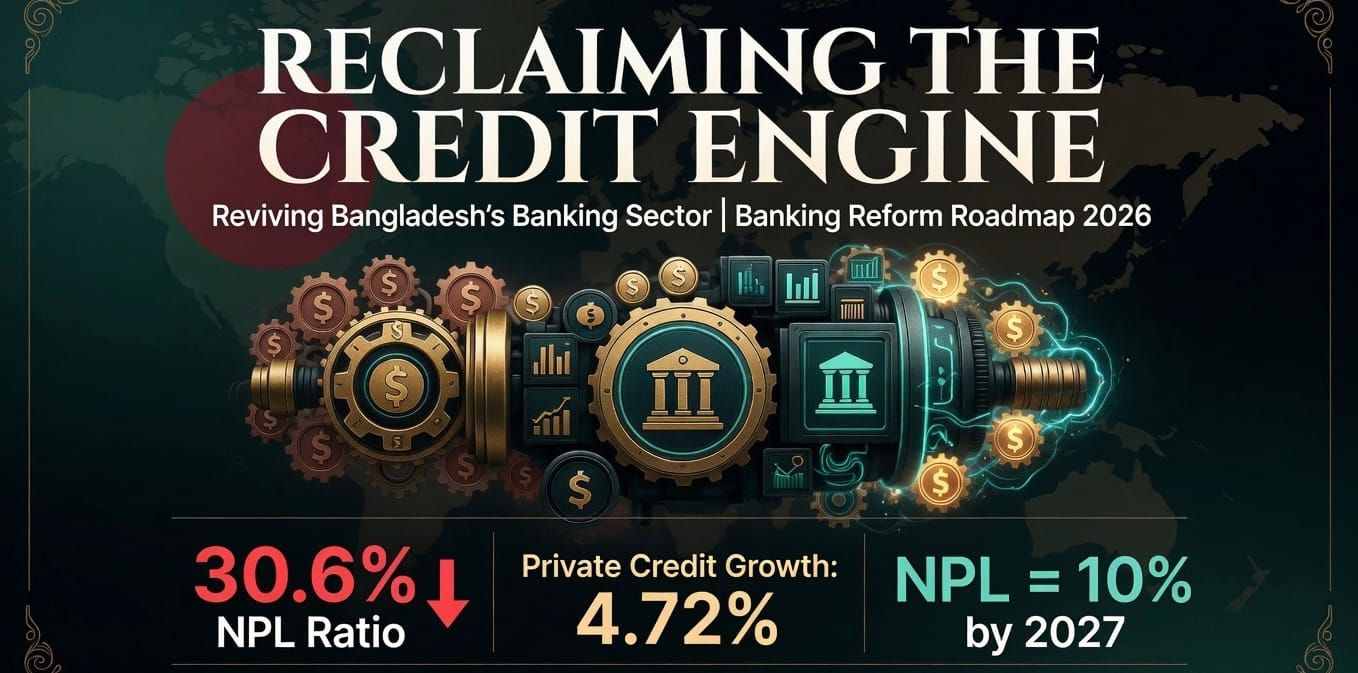
No economy grows sustainably when its banks cannot lend with confidence. Every factory that doesn't get funded, every SME that can't access credit, every entrepreneur who turns to informal money lenders at extortionate rates — these are not statistics. They are Bangladesh's future, slowly suffocating. The good news: suffocation can be reversed. The tools exist. The roadmap is clear. What is needed now is the resolve to execute.
In three previous instalments of this series, we confronted Bangladesh's macroeconomic slowdown, its chronic fiscal under-investment, and the strategic imperative of export diversification. All three threads lead back to the same choke point: a banking sector so burdened by non-performing loans, political lending, and regulatory forbearance that it has largely ceased to function as an engine of productive growth. This piece is about unblocking that engine — deliberately, systematically, and without flinching from the diagnosis.
The Anatomy of a Crisis — Named in Numbers
Let us start with the data, because the data is shocking enough to command the full weight of policy attention it deserves.
Dec 2025
Q1 2025
March 2026 (24-yr low)
H2 FY2025–26
Dec 2025 (up from $25.6B)
The headline NPL figure of 30.6% — down from a record 35.7% in September 2025 — is not a sign of recovery. It is the result of a special rescheduling policy allowing over 1,300 companies to regularise defaulted loans at a 2% down payment over ten years. The underlying disease has been managed, not cured. In the business and trade sector alone, NPLs stood at 42% of all loans disbursed as of December 2025 — a figure that would represent a systemic crisis in any country on earth.
The human cost is being felt by precisely the businesses least responsible for the crisis. Private sector credit growth fell to a 24-year low of 4.72% in March 2026. Commercial lending rates — pushed to roughly 15% by a 10% policy rate — have made financing prohibitively expensive, particularly for the small and medium enterprises that employ most of Bangladesh's workers. Imports of capital machinery have declined. Industrial expansion has slowed. The credit engine is stalled.
There is an important distinction that honest analysis demands we make: a significant portion of the NPL surge in 2025 is a measurement correction, not a new deterioration. Bangladesh Bank's adoption of international Basel III standards — classifying loans as non-performing after three months of non-payment rather than six — exposed bad debt that had been technically hidden. That transparency is itself a reform. You cannot fix what you cannot see.
"The surge in NPLs is partly a measurement correction. But once you see it clearly, you are obligated to act — and the scale of what's been revealed is sobering."
— BBF Digital, March 2026 · Why 2025 Marked a Turning Point| Bank Type | Bad Loans (Tk Crore) | NPL Ratio | Risk Level |
|---|---|---|---|
| State-owned Commercial Banks | 1,46,407 | 46.0% | Critical |
| Private Commercial Banks | 2,64,195 | 20.16% | Elevated |
| Specialised Banks | 6,494 | 14.47% | High |
| Foreign Banks | 3,239 | 4.83% | Manageable |
| Total Banking Sector | 4,20,335 | 24.13% | Systemic |
What Is Already Happening — The Reform Architecture
This is not a story of paralysis. The interim administration that governed from August 2024 through February 2026 did more to restructure the legal and regulatory foundation of Bangladesh's banking system in eighteen months than was accomplished in the preceding decade. The newly elected government of Prime Minister Tarique Rahman, which took office on February 17, 2026, now inherits both that architecture and the responsibility to sustain it. That continuity deserves clear acknowledgement — because the work ahead will only be sustained if people see, honestly, how much has already been built.
2025
Bank Resolution Ordinance
Grants Bangladesh Bank powerful new tools to resolve failing banks — including bridge bank mechanisms to protect depositors. Provides legal protection for regulators and limits judicial interference in the resolution process. This is the regulatory equivalent of installing fire exits before the blaze.
2025
Basel III Loan Classification Adoption
Loans now classified as non-performing after 3 months of non-payment (down from 6). Aligns Bangladesh with international standards. Short-term: NPL numbers rose sharply. Long-term: balance sheet integrity is restored, enabling honest lending decisions. Bold and correct.
2026
Risk-Based Supervision Rollout
Bangladesh Bank consolidates supervision into single teams per bank and launches risk-based oversight. Pilot inspections completed for 20 banks covering nearly 50% of system assets. The shift from reactive to proactive regulation is the institutional transformation that everything else depends on.
Target
Distressed Asset Management Ordinance
Creates a legal framework for private asset management companies to trade NPLs — allowing banks to offload bad debt and clean balance sheets without using public funds to buy private bank loans. A World Bank team is advising on the design. Expected completion: June 2026.
2027
IFRS 9 Provisioning Standards
Commitment to implement the global standard for loan-loss provisioning — requiring banks to estimate expected future losses, not just recognise losses after they occur. Interim prudential buffers are already in place. This is the final piece of the international credibility puzzle.
Alongside the legal architecture, strict deadlines have been set: state-owned banks are required to reduce their NPL ratio to 10% by June 2026; private banks must target below 5%. Whether these targets are met on schedule is less important than the discipline of having them — measurable, public, and held to account by both the IMF and a newly elected parliament.
Global Lessons — Countries That Fixed What Bangladesh Is Facing
Bangladesh is not the first country to face a banking system captured by political lending, bloated with bad debt, and unable to support productive growth. The global playbook exists. The question is which lessons apply — and which mistakes to avoid.
KAMCO: The Asset Management Blueprint
After the 1997 Asian financial crisis, Korean banks held NPL ratios exceeding 30%. The Korea Asset Management Corporation (KAMCO) purchased NPLs from banks at fair market value — funded by public bonds — then used pro-market techniques including international auctions to recover value. Over USD 100 billion in distressed assets were resolved in five years.
IBC + EASE: The Dual-Track Reform
India's Insolvency and Bankruptcy Code (2016) combined with the government's EASE (Enhanced Access and Service Excellence) reform programme transformed 12 public sector banks from uniformly loss-making to uniformly profitable by 2022. The IBC gave creditors legal teeth; EASE gave bank management accountability frameworks and technology mandates. Neither alone was sufficient.
Bank Consolidation Under Crisis Conditions
Ghana's banking sector carried similar structural problems — politically connected lenders, capital shortfalls, and NPLs above 20%. The Bank of Ghana raised minimum capital requirements, consolidated 23 banks into 23 stronger ones, and wound up insolvent institutions — all within three years. The process was painful and cost 4,600 jobs, but restored depositor confidence within 18 months.
Digital Infrastructure as a Credit Enabler
Rwanda built a national digital payments backbone (Momo Pay / Irembo) that created the transaction data necessary to underwrite credit for small businesses previously invisible to formal lenders. SME lending grew by 40% in the decade following the infrastructure rollout, even as traditional bank NPLs were being restructured. Digital identity + payment data = collateral substitute.
The common thread across all four cases is institutional sequencing: legal framework first, transparency second, capital adequacy third, credit expansion fourth. Bangladesh is executing steps one and two with greater urgency than at any point in its banking history. Steps three and four — and the economic growth they unlock — follow logically if the sequence is maintained.
The Monetary Policy Dilemma — And How to Navigate It
Bangladesh Bank faces the central paradox of monetary policy in a recovering economy: the same tight stance intended to control inflation is simultaneously choking the private credit necessary for growth. But before we can prescribe the right policy response, we must correctly diagnose the disease. And on inflation, the mainstream diagnosis has been dangerously incomplete.
Bangladesh's inflation is not primarily demand-driven. It is cost-push inflation — rooted in supply-side shocks largely outside the central bank's control. CPD's Dr. Fahmida Khatun stated this plainly: "structural problems, not demand, are behind Bangladesh's inflation." Economists at the University of Dhaka and the Institute for Inclusive Finance and Development have echoed the same diagnosis. The data supports it. Bangladesh is a net importer of fuel and food. Inflation has been running above 8% for over 40 consecutive months — yet private sector credit growth is at a 24-year low of 4.72%. If this were demand-driven inflation, credit would be growing. It is not. Consumers are not borrowing and spending their way to higher prices. They are being squeezed by costs they cannot control.
"Monetary policy alone cannot control inflation in Bangladesh. Supply-side factors are a major driver — limiting the effectiveness of interest rate adjustments on their own."
— Mustafa K. Mujeri, Executive Director, Institute for Inclusive Finance and Development · Daily Star, November 2025This distinction is not academic. The policy response to demand-pull inflation (tighten monetary conditions, reduce liquidity) is fundamentally different from the response to cost-push inflation (protect supply chains, reduce import costs, improve market efficiency). Applying the first remedy to the second disease doesn't cure the patient — it simply adds the pain of credit contraction on top of the pain of price increases. Bangladesh has been doing exactly this for over three years, and ordinary households are paying the price.
The good news: correctly diagnosing the problem opens the door to a broader, more effective toolkit. The new government — and Governor Mostaqur Rahman at Bangladesh Bank — can address inflation from both the monetary and the supply side simultaneously. That is not just a better policy approach. It is the only one that can work.
| Inflation Driver | Root Cause | Policy Response | Owner |
|---|---|---|---|
| Imported Energy Costs Transport +9.3% · Housing +8.9% |
Bangladesh is a net fuel importer; Middle East conflict and supply chain disruption raise LNG and oil import prices | Negotiate longer-term LNG supply contracts to reduce spot-price exposure; accelerate domestic renewable energy (solar) capacity to reduce import dependency; rationalise capacity payments to private power plants that inflate electricity tariffs | Ministry of Energy + BPDB |
| Food Price Volatility Food CPI +8.4% · 41+ months elevated |
Supply disruptions, flood damage to haor crops, import price pass-through, weak storage infrastructure, middlemen market distortion | Reduce import duties on essential commodities (rice, edible oil, lentils) during supply shocks; build strategic food buffer stocks; invest in cold-chain infrastructure to reduce post-harvest loss (estimated at 20–30% of produce); strengthen market monitoring to break artificial price floors by intermediaries | Ministry of Commerce + Ministry of Agriculture + TCB |
| Exchange Rate Pass-Through Taka depreciation → import cost inflation |
Taka depreciated significantly against USD, making all imported goods — fuel, food, capital goods — more expensive in taka terms | Maintain market-based exchange rate (correct policy, already adopted May 2025); grow remittance inflows through formal channels to support taka; build FX reserves buffer to intervene on extreme volatility; expand export earnings to rebalance currency supply/demand structurally | Bangladesh Bank + NBR + BEZA |
| Market Structure Failures Structural inflation 40+ months |
Oligopolistic intermediary chains capture margins; weak competition enforcement; poor logistics infrastructure inflating distribution costs | Enforce the Competition Act 2012 with real penalty power; mandate price transparency on essential goods (digital price boards at wholesale markets); fast-track highway and port logistics investment to reduce distribution cost by 15–20%; expand TCB (Trading Corporation of Bangladesh) direct-to-consumer sales during price spikes | BSEC + Ministry of Commerce + BRTC |
| Monetary Policy Role Supporting role, not lead instrument |
Tight monetary policy limits second-round inflationary effects (workers demanding higher wages, expectations becoming entrenched) — but cannot fix supply constraints | Maintain 10% policy rate until inflation is sustainably below 7%; begin gradual rate reduction once real rate ≥ 3%; accompany rate cuts with clear communication on inflation targets to anchor expectations; ensure monetary-fiscal coordination to avoid government borrowing undermining tightening | Bangladesh Bank MPC |
The Taylor Rule Applied to Bangladesh's Context
At current parameters, a Taylor Rule would suggest a policy rate of approximately 9.5–10.5% — consistent with the current 10% stance. Critically: the negative output gap (β term) already argues for lower rates, but the above-target inflation (α term) dominates. Once inflation falls to 7%, the output gap term wins — and a 200–250 basis point rate reduction over 12–18 months becomes mathematically justified. The supply-side measures in the table above are what gets inflation to 7%. Monetary tightening alone cannot.
Monetary Dashboard — Bangladesh FY2025–26
Signal: Will cut when real rate ≥ 3% and inflation shows sustained decline below 7%. Correct stance for now.
Signal: Monetary tightening alone is insufficient — supply-side and fiscal measures are urgently required.
Signal: Strongest since 2022. Taka stability reduces imported inflation pass-through.
Signal: Inflation is not demand-driven. Credit contraction is causing growth pain without curing prices.
Signal: Confidence returning selectively. Weak banks need resolution, not delay.
The critical insight for Governor Mostaqur Rahman and the new government is that the sequencing of actions determines whether the medicine works. Cutting rates prematurely — before NPLs are resolved and bank balance sheets are clean — risks flooding a broken credit system with cheap money that goes to the wrong borrowers. But waiting indefinitely while supply-side inflation festers also kills growth. The path through is to run all policy tracks in parallel: fight cost-push inflation with supply-side tools, maintain monetary discipline until inflation is genuinely subdued, and clean bank balance sheets simultaneously so that when rates finally do come down, the credit system is ready to deliver.
The critical insight for Governor Mostaqur Rahman and the new government is that the sequencing of actions determines whether the medicine works. Cutting rates prematurely — before NPLs are resolved and bank balance sheets are clean — risks flooding a broken credit system with cheap money that goes to the wrong borrowers. Tightening monetary policy indefinitely while supply-side inflation festers also kills growth needlessly. The three tracks above must run in parallel. Bangladesh has the institutional capacity to do this. What it needs now is the political coordination to ensure all three ministries and the central bank are rowing in the same direction.
The Five-Point Recovery Prescription
Drawing on the reform architecture already in place, the global lessons that apply to Bangladesh's conditions, and the monetary math, here is a specific, sequenced prescription for restoring the credit engine over a 36-month horizon.
| Phase | Action | Owner | Target Metric |
|---|---|---|---|
| 0–12 mo Stabilise |
Complete Asset Quality Reviews (AQRs — independent audits of each bank's loan portfolio conducted by international firms like KPMG or EY) for all state-owned banks; enforce merger/resolution of banks with NPL > 40%; pass Distressed Asset Management Ordinance | Bangladesh Bank + Ministry of Finance | State-owned Bank (SOB) NPL ≤ 25% |
| 6–18 mo Recapitalise |
Require private banks below capital adequacy minimums to raise equity; enable private Asset Management Company (AMC) market to begin Non-Performing Loan (NPL) trading; enforce new provisioning buffers. Already underway: Governor Mostaqur Rahman issued a directive on May 23, 2026 requiring banks to hold a minimum paid-up capital of Tk 2,000 crore before they may declare any cash dividend — a direct tool to force retained-earnings recapitalisation across the sector. | Bangladesh Bank + Bangladesh Securities Commission (BSC) + Private Sector | Capital Adequacy Ratio (CAR) ≥ 12.5% all banks |
| 12–24 mo Rate Pivot |
Begin gradual policy rate reduction cycle — 50 bps per quarter — once inflation is sustainably below 7% and real rate exceeds 3%; accompany with clear forward guidance | Bangladesh Bank Monetary Policy Committee (MPC) | Policy rate: 7.5–8% |
| 18–30 mo Credit Revival |
Mandate SME credit quotas (minimum 25% of private bank portfolios); launch national credit guarantee scheme backed by 0.5% of GDP; deploy bKash/digital Digital Public Infrastructure (DPI) for MSME underwriting | Bangladesh Bank + Finance Ministry + Private Banks | Private credit growth ≥ 12% |
| 24–36 mo Consolidate |
Implement International Financial Reporting Standard 9 (IFRS 9) provisioning — the global standard requiring banks to estimate expected future losses rather than only recognise past ones; complete privatisation or strategic partnership for 2–3 state-owned banks; launch capital market deepening initiative to reduce bank-dependency of corporate finance | Bangladesh Bank + Bangladesh Securities and Exchange Commission (BSEC) + Finance Ministry | State-owned Bank (SOB) NPL ≤ 10% · System NPL ≤ 8% |
The SME credit mandate deserves particular emphasis. Bangladesh's small and medium enterprises contribute approximately 25% of GDP — compared to 52% in Sri Lanka, 40% in Pakistan, and 30% in India. The gap is almost entirely a financing gap: SMEs cannot access formal credit at affordable rates because they lack collateral and because banks, burdened by NPLs, have retreated to the safest, largest borrowers.
The solution Bangladesh already has in its hands but has not yet fully deployed: the digital payments infrastructure built by bKash. City Bank's nano-loan programme, distributed through bKash, had already disbursed approximately USD 190 million to 950,000 users by April 2025 — using transaction history as collateral substitute. This is not a pilot. It is a proof of concept for mass SME credit delivery at scale. Bangladesh Bank should formalise and accelerate this model: transaction data as underwriting input, digital credit scoring as a regulatory-approved credit framework, and a partial government guarantee to de-risk the first generation of unsecured SME loans.
The Credit Guarantee Multiplier
Leverage ratio = 1:8 (guarantee covers 12.5% of loan value)
Total credit unlocked = Tk 64,000 Crore (~USD 5.8B)
The Political Economy — Why This Time Must Be Different
Every analysis of Bangladesh's banking sector eventually arrives at the same uncomfortable paragraph. The NPL crisis is not primarily a banking problem. It is a political problem that expressed itself through banking. Loans that were never intended to be repaid — directed to political cronies, routed to overseas real estate, extracted from state-owned institutions as patronage — did not accumulate because of poor credit analysis. They accumulated because the regulatory and judicial system was too captured to prevent them.
The interim administration arrested and prosecuted some of the most egregious defaulters. It replaced politically appointed bank boards. It invited the IMF and World Bank into the reform process with unusual transparency. These were institutional changes of a different order than cosmetic reshuffles, and they deserve full recognition. The newly elected BNP government of Prime Minister Tarique Rahman, which assumed office in February 2026, now inherits this foundation — and carries the full weight of a democratic mandate to either honour it or squander it.
"Sustaining momentum behind tough, unpopular decisions — including enforcing mergers and holding powerful defaulters personally liable — will require the kind of political commitment that has historically been in short supply."
— BBF Digital, March 2026 · Why 2025 Marked a Turning PointThe new government faces a choice that is both economic and national in character. It can use the banking system as its predecessors did: as an instrument of patronage, directed lending, and politically convenient forbearance. That path leads, inexorably, to the crisis Bangladesh is now paying to clean up. Or it can treat the banking system as what it fundamentally is: the circulatory system of the national economy, the mechanism through which savings are converted into investment, through which entrepreneurs are funded and workers are employed.
The second path is harder in the short run. It requires saying no to powerful interests. It requires enforcing court judgments against defaulters who have the resources to resist them. It requires letting some banks fail when the alternative is propping them up with public money. It also leads to a Bangladesh where a small business owner in Sylhet can get a working capital loan on commercially rational terms; where a young entrepreneur in Chattogram can raise seed capital without a political connection; where the savings of the millions of Bangladeshis who trusted the banking system are actually safe. That Bangladesh — credit-worthy, transparent, and dynamically financed — is entirely within reach.
The Patriotic Case for Banking Reform
I want to end where all honest analysis of Bangladesh eventually leads: with hope grounded in evidence rather than sentiment.
The NPL figures in this article are not evidence of a broken nation. They are evidence of a nation that finally chose to look honestly at a problem it had been encouraged to look away from for decades. That choice — to see clearly, classify truthfully, and begin cleaning systematically — is the hardest and most important step. Bangladesh has taken it. The architecture of reform is in place. The global playbook exists. The demographic dividend — 170 million people, half of them under 28, increasingly educated, increasingly connected — remains the most powerful economic asset in South Asia.
What banking reform unlocks is not abstract. It is the garment factory in Narayanganj that can finance a capacity expansion. It is the tech startup in Dhaka that can raise seed capital without emigrating. It is the rice farmer in Rangpur who can access crop insurance and pre-harvest finance at a rate that doesn't erase the margin. It is the remittance from Riyadh flowing into a savings account, not a mattress, because the account holder trusts the institution holding their money. These are the transactions that compound — over years, over generations — into the upper-middle-income Bangladesh that this generation of leaders has the opportunity to deliver.
The credit engine is stalled, not broken. With the right sequence of reforms, executed with the political courage the moment demands, Bangladesh can restart it within three years and run it clean for a generation. That is not a dream. It is a technical plan — supported by data, validated by history, and owed to the 170 million people who have already demonstrated, in a hundred other ways, that they will do their part if their institutions do theirs.
— Mustafizur Rahman Shazid
CEO · Board Director · Strategic Advisor
Houston, Texas · Dhaka, Bangladesh
A question for you: What do you believe is the single greatest obstacle to banking reform in Bangladesh — political will, institutional capacity, or judicial enforcement? I welcome the conversation.