
The 2026 Midterm Wave Reshapes 2028

The 2026 Midterm Wave Reshapes 2028
A nonpartisan, data-grounded reading of the November 3 midterms — who moved, why, what each party got right and wrong, and the structural map both face in 2028.
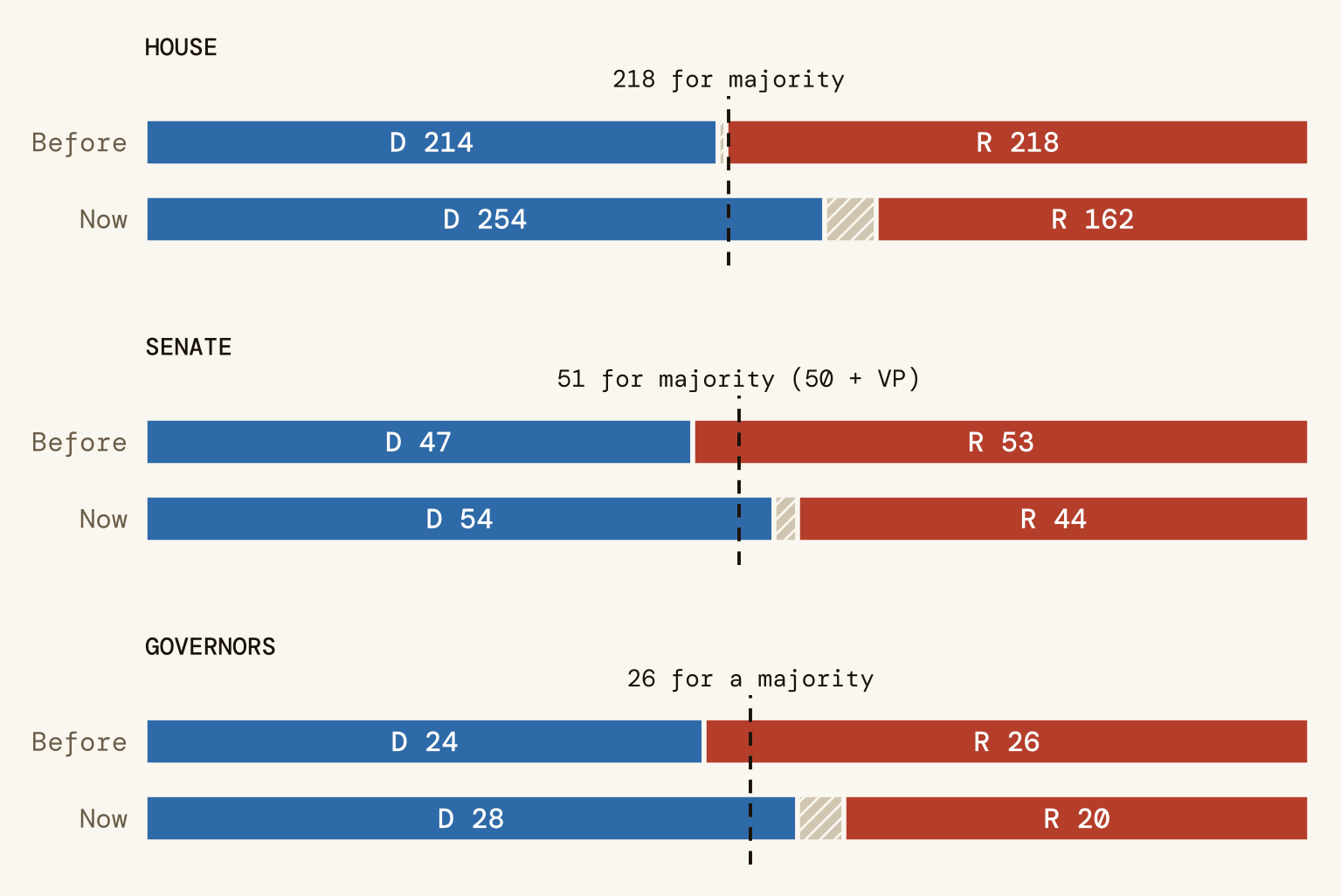
Democrats won the November 3, 2026 midterms by the widest national House margin for either party in a midterm since 1974, about 13 points in the latest counts. They are taking a House majority projected in the mid-to-high 250s, a Senate majority of 54 to 56 seats (Alaska and Mississippi are uncalled), and 28 to 30 governorships. The result exceeds every standard benchmark for a president's party: the post-war average midterm loss of about 25 House and 4 Senate seats, the 37-seat average when the president's approval is below 50%, and every prior second-term midterm in the modern series. Voter-poll estimates show that much of the 2024 shift toward Republicans among Latino, young, Black male and independent voters reversed. The education divide held at about 30 points, and white non-college and rural voters stayed Republican. Cost of living was the dominant issue, driven by an energy shock from the Iran war, tariffs and health-premium increases. Concern about corruption and about checks on the presidency came close behind, and Republicans kept a trust edge only on immigration, by about 3 points. A rough breakdown of voter-poll data suggests that about two-thirds of the national swing came from who turned out, chiefly 2024 Trump voters staying home, and one-third from voters switching sides. That split is the central uncertainty for 2028, because presidential electorates are larger and include the low-propensity voters who favored Trump. Midterm waves are weak predictors of the next presidential race. The closest structural parallel is 2006, when a term-limited president's party lost heavily during an unpopular war, and the out-party won the White House two years later. On the 2028 map, Democrats can reach exactly 270 electoral votes through the Rust Belt or 275 through the Sun Belt. The 2028 Senate class is roughly balanced. The House map is shaped by Republican-drawn districts that underperformed in a wave but would likely perform closer to design in a neutral year, plus new redraws on both sides after Louisiana v. Callais.
Data status (read first)
- Counting is incomplete. The latest AP House count (Saturday morning, Nov. 7) left 19 House races uncalled. The Alaska and Mississippi Senate races are uncalled, as are the Kansas governorship (Democratic-held) and the Alaska governorship (Republican-held, open). Louisiana's 6th District goes to a Dec. 12 runoff. Where outcomes are pending, this report gives ranges, not single figures.
- Exit and voter polls are statistical estimates, not counts. In 2026 a single SSRS-run "Voter Poll" served AP, ABC, CBS, CNN, Fox News, NBC and MS NOW, replacing both AP VoteCast and the Edison exit poll. Releases are still being reweighted and already differ by 1–3 points. Subgroup estimates carry wider error than the national ±0.5–0.6 points.
- Cross-survey comparisons are approximate. Every 2024-to-2026 "shift" here compares a new 2026 instrument with a different 2024 survey (AP VoteCast, the preliminary Edison exit poll, or Pew's validated-voter study), and usually compares a 2026 House vote with a 2024 presidential vote. The urban/suburban/rural question changed in 2026, so geographic comparisons with 2024 are not like-for-like.
- Sourcing flags. Figures sourced only to a headline are marked (headline only). 2024 state presidential margins are certified results as compiled by PollCheck. Where notes conflicted, this report uses the latest dated figure and says so.
- Stance. This report evaluates strategies by electoral incentives, voter behavior and data. It does not judge either party's ideology or policies as correct.
Executive summary: a 13-point national margin that reached deep-red states

Congress changed hands: a mid-250s House majority and a 54-to-56-seat Senate
The House. AP's count as of Saturday morning, Nov. 7, stood at 254 Democratic seats, 162 Republican and 19 uncalled; 218 is the majority threshold (Yahoo News/AP). Democrats entered the election with 214 seats to Republicans' 218, with one independent and two vacancies (State of the People). CBS counted 44 Democratic pickups and 2 Republican pickups (TX-32 and TN-9, both in redrawn districts) as of Nov. 6 (CBS News). Newsweek lists ME-2 as a third Republican pickup, which CBS had not counted (Newsweek). Final projections cluster between about 255 (Yahoo News, Romano) and 259 (the NYT projection, via Welcome), with NBC at 258 (State of the People). That implies a net Democratic gain of roughly 41 to 45 seats. Even the low end would be the largest majority for either party since Democrats won 257 in 2008 (Roll Call). CNN reported about 30 Republican incumbents defeated (as relayed by State of the People); a verified list was not available.
The notable uncalled seats lean Democratic but are not settled. In CO-4, Democrat Eileen Laubacher led Rep. Lauren Boebert (R) by 3,172 votes (48.8%–47.9%) with 97% counted; counties have until Nov. 13 to finish (Yahoo News/AP). Democrats also led in NC-1, FL-9 and TN-4, and LA-6 goes to a Dec. 12 runoff (RealClearPolitics).
The national House vote. Cook Political Report's tracker had Democrats ahead by 12.8 points with more than 113 million votes counted late on Nov. 6 (Yahoo News/AP). Projections of the final margin run from D+13 (Brookings) to D+14 (Politico via Yahoo). No party had won a midterm House vote by that much since 1974. Republicans' margins in their 1994 and 2010 wave years were 6.8 points each (Yahoo News, Romano). The polls understated Democrats: the generic-ballot average on Oct. 9 was D+8.4 (Wikipedia), so the result ran about 4–5 points ahead of it.
The Senate. Republicans entered with 53 seats to 45 Democrats and 2 independents (Wikipedia). Democrats flipped seven Republican-held seats (TX, OH, NC, ME, IA, KS, SC) and lost none. That gives them 54 seats (including independents) to 44 Republicans, with Alaska and Mississippi uncalled (Yahoo News/AP). CBS projected Democratic control at 11:44 p.m. ET on Election Night (CBS News). Both uncalled seats are Republican-held and Democrats lead in both, so the final range is 54–46 to 56–44.
| State | Winner | Defeated | Preliminary margin | Status |
|---|---|---|---|---|
| Texas | James Talarico (D) | Ken Paxton (R) | 55.1–43.0 (D+12.1, 99% in) | Flip |
| North Carolina | Roy Cooper (D) | Michael Whatley (R) | 58.7–39.2 (D+19.5) | Flip |
| Ohio (special) | Sherrod Brown (D) | Sen. Jon Husted (R, appointed) | ~D+2 (48.5–46.6 at 88% counted) | Flip |
| Iowa | Josh Turek (D) | Ashley Hinson (R) | 50.8–46.1 (D+4.7) | Flip |
| Kansas | Adam Hamilton (D) | Sen. Roger Marshall (R) | 50.9–46.1 (D+4.8, 95.6% in) | Flip |
| South Carolina | Annie Andrews (D) | Sen. Darline Graham (R, appointed)* | 50.6–47.2 (D+3.4, ~93% in) | Flip |
| Maine | Troy Jackson (D) | Sen. Susan Collins (R) | ~D+6–7 (partial count) | Flip |
| Georgia | Sen. Jon Ossoff (D) | Mike Collins (R) | ~59–41 | D hold |
| Michigan | Abdul El-Sayed (D) | Mike Rogers (R) | ~7 pts (secondhand, see note) | D hold |
| New Hampshire | Chris Pappas (D) | John Sununu (R) | not retrieved | D hold |
| Florida (special) | Sen. Ashley Moody (R) | Angie Nixon (D) | 50.8–47.9 (R+2.9) | R hold |
| Louisiana | Julia Letlow (R) | — | under 2 pts | R hold |
| Nebraska | Sen. Pete Ricketts (R) | Dan Osborn (I) | not retrieved | R hold |
| Alaska | Mary Peltola (D) leads Sen. Dan Sullivan (R) | — | 48.02–47.72, 637 votes, 74% counted | UNCALLED; ranked-choice tabulation Nov. 18 |
| Mississippi | Scott Colom (D) leads Sen. Cindy Hyde-Smith (R) | — | 49.1–48.8, ~2,500–2,600 votes, 97% counted | UNCALLED; certification by Nov. 13 |
Sources: CBS News (calls, and the Michigan margin as stated by Rep. Hillary Scholten); WBEZ (TX); State of the People (NC, IA, KS, SC, ME); Newsweek (OH); Newsweek (GA); WUSF (FL); Roll Call (LA); Alaska's News Source (AK); Yahoo News/AP (MS). Texas margins reported early on Nov. 4 were lower (D+9.7); this table uses the later 99%-counted figure.
* Sen. Lindsey Graham died suddenly in July 2026. His sister, Darline Graham, was appointed to serve out his term and then won a special primary to take his place on the November ballot (CBS News). Andrews therefore defeated an appointed incumbent.

Two Senate details set the scale. Talarico received 5.45 million votes, the most ever for a Texas Democrat, and is the first Democrat elected to the Senate from Texas since 1988 (Yahoo News, Romano). Hamilton's win is the first Democratic Senate victory in Kansas since 1932 (Brookings). The two uncalled races are being contested through standard processes. Mississippi has no recount law; mail ballots postmarked by Election Day count if received by Nov. 10 (Yahoo News/AP). Estimates of the outstanding Mississippi ballots range from about 3,100 mail ballots plus affidavit ballots (AP) to about 20,000 in total. The Hyde-Smith campaign and the NRSC have asked counties to set affidavit ballots aside (Spokesman-Review). In Alaska, the Sullivan campaign alleges ballot confusion caused by a second "Dan Sullivan" on the ballot, which Peltola's campaign calls "fictitious" (Alaska's News Source). A Justice Department suit to block certification was dismissed, and DOJ said it would appeal (Spokesman-Review).
Governors: five flips in Trump-won states and 28 to 30 Democratic seats
Republicans entered with 26 governorships to Democrats' 24 (PBS/AP). Democrats flipped five, all in states Trump carried in 2024:
- Georgia: Keisha Lance Bottoms defeated Rick Jackson, 54.2–45.8. Jackson had spent more than $200 million of his own money.
- Texas: Gina Hinojosa unseated Gov. Greg Abbott, 52.8–45.7, despite being outspent 5-to-1 on ads.
- Ohio: Amy Acton defeated Vivek Ramaswamy.
- Iowa: Rob Sand defeated Zach Lahn.
- Nevada: Aaron Ford defeated Gov. Joe Lombardo.
Sources: PBS/AP; State of the People; CBS News. No Republican flip has been reported.
Two races remain uncalled. Kansas is Democratic-held (Gov. Laura Kelly is term-limited). Democrat Cindy Holscher leads Ty Masterson by just over 7,000 votes, and a state-required hand-count audit is under way (Yahoo News/AP). A Holscher win would be a hold, not a flip; one post-election tally that lists Kansas among possible Democratic flips is in error. Alaska is Republican-held and open. Democrat Jonathan Kreiss-Tomkins leads with 49.1% of first-choice votes to Republican Bernadette Wilson's 29.2%, with 74% counted, and the race may go to ranked-choice tabulation (Yahoo News/AP). MultiState already lists Alaska as a flip (MultiState), but no AP call was found, so this report treats it as uncalled.
Computed from these results, Democrats have 28 secured governorships and the final range is 28 to 30 Democratic and 20 to 22 Republican. That is the party's first majority of governorships since the 2010 elections; NBC and Stateline headlines say "first time in 16 years," while AP's "two decades" framing differs. About three-quarters of Americans will live in Democratic-governed states (Silver Bulletin).
Several incumbents and open-seat winners are 2028-relevant. Josh Shapiro won 60.3–38.4 in Pennsylvania (Newsweek), JB Pritzker won a third term 59.8–36.8 in Illinois, and Katie Hobbs won 56.9–41.5 in Arizona (State of the People). Democrats also won open seats in Michigan (Jocelyn Benson), Wisconsin (David Crowley, 54.1–45.9), California (Xavier Becerra), New Mexico (Deb Haaland) and Minnesota (Amy Klobuchar) (PBS/AP; MultiState). Republicans held three governorships: Florida, where Byron Donalds won 50.1–48.7 and becomes the state's first Black governor-elect; New Hampshire (Kelly Ayotte); and South Carolina (Alan Wilson) (State of the People; MultiState). Politico reports Democrats will hold governorships in "all 10 presidential battleground states" (Politico via Yahoo), but New Hampshire's Republican hold means that list must exclude it. Nate Silver notes that mapping the governor results onto the Electoral College produces a "392–146 landslide," and he cautions that the results "take some care to interpret."
State legislatures: six new Democratic trifectas and four Republican ones broken
The DLCC reported 12 legislative chambers flipped to Democrats as of Nov. 4–5, but published coverage names only some of them (Stateline via CT Mirror):
- Arizona: both chambers (unofficial), the first Democratic control in 60 years.
- North Carolina House: the first Democratic control since 2010.
- Texas House: Roll Call, citing AP, reports a flip (Roll Call); Stateline called it not yet final.
- Pennsylvania Senate (Brookings).
NCSL projects five new Democratic trifectas (Michigan, Minnesota, Nevada, Pennsylvania, Wisconsin). AP adds Arizona, the party's first trifecta there since 1966, for six. Democratic governor wins broke Republican trifectas in Georgia, Iowa, Ohio and Texas. Republican supermajorities fell in the Florida, Indiana, Kansas, Ohio and South Carolina houses and in both Missouri chambers (Stateline via CT Mirror). Democrats now control more than half of state legislative chambers; Republicans had held a majority of legislatures and governorships since 2010.
The practical effect is on veto points. Losing those supermajorities ends veto-proof Republican control in six states, which narrows the path for further mid-decade Republican redraws there. The new Democratic trifectas in Minnesota, Wisconsin and Pennsylvania face state-constitutional limits on aggressive mapmaking (Section 5).
Redistricting: Republican-drawn maps delivered two of the fifteen seats they targeted
The most consequential structural finding concerns maps. Republicans redrew congressional districts mid-decade to gain 15 seats in Texas, Florida, Ohio, North Carolina, Tennessee, Alabama and Louisiana. As of Nov. 5 they were projected to win two (TX-32 and TN-9). California's Proposition 50 counter-map delivered all five targeted Democratic gains (RealClearPolitics). Brookings found that Democrats netted three of the 19 seats most affected by redistricting (Brookings).
| State | Map and drawer | Target | Preliminary outcome |
|---|---|---|---|
| Texas | Republican mid-decade | +5 R | Republicans won only TX-32. Democrats held TX-28 and TX-34, won the redrawn TX-9 and TX-35, and flipped TX-15 and TX-23. The delegation ended 24 R–14 D. |
| Florida | Republican mid-decade | +4 R | 0 of 4 so far; FL-9 uncalled with Soto (D) ahead |
| Ohio | Commission map, locked until 2032 | +2 R | 0. Democrats held OH-1 and OH-9 and flipped OH-7, OH-10 and OH-15. The delegation ended 7 R–8 D. |
| North Carolina | Republican mid-decade | +1 R | NC-1 uncalled with Davis (D) ahead; Democrats flipped NC-6, -9, -11, -13 and -14 |
| Tennessee | Republican mid-decade | +1 R | Republicans won TN-9; TN-4 uncalled with the Democrat ahead |
| Alabama | Redrawn after Milligan injunction lifted | +1 R | Democrats held AL-2 |
| Louisiana | Redrawn after Callais | +1 R | LA-6 goes to a Dec. 12 runoff |
| Missouri | Republican 2025 map | +1 R | Never took effect; voters rejected it (Prop A, 62–38); Democrats flipped MO-2 |
| California | Prop 50 (Democratic) | +5 D | 5 of 5 (CA-1, -6, -22, -41, -48) |
| Utah | Court-ordered | +1 D | UT-1 flipped |
| Virginia | Democratic referendum map | up to +4 D | Struck down by the state Supreme Court; Democrats won 8–3 on the 2021 map |
| Indiana | Republican map rejected by the state Senate | — | Democrats flipped IN-5 |
Sources: RealClearPolitics; CBS News "dummymander" guide; CBS News flips; State Court Report; Wikipedia, 2025–26 redistricting.

The mechanism is the textbook "dummymander," the label CBS applies to Texas, Ohio, North Carolina and Alabama. A map that spreads a party's voters thinly to win many seats in a modest environment exposes those seats when the environment swings by double digits. Some Republicans said so: one House Republican called the redraws "definitely the wrong move" and part of "the reason for the backlash" (Fox News). The 2028 implication runs the other way. In a neutral environment, these maps would likely perform closer to design (Section 5).
What is a “dummymander”?
A gerrymander spreads a party’s voters thinly across many districts so it wins each by a modest margin. That maximizes seats in an ordinary year but leaves every one of those seats exposed when the national environment swings by double digits. The result is a map that backfires on the party that drew it. The same map can perform close to design when the environment returns to neutral.
Ballot measures: voters backed abortion rights and stricter voting rules at the same time
Ballot-measure results did not move in one ideological direction, and that is itself evidence about the election. Unless noted, the results below are from State Court Report and Ballotpedia News; some were preliminary.
Abortion. Abortion-rights positions won three of four contests:
- Missouri rejected Amendment 3, which would have repealed its 2024 abortion-rights amendment (about 55% no).
- Nevada approved Question 6 (over 60%).
- Virginia approved a reproductive-freedom amendment.
- Idaho rejected Prop 1, which would have created a statutory abortion right (56% no).
Voting rules. Voters largely approved Republican-favored proposals:
- Voter ID passed in Nevada, North Carolina and Ohio. It failed in California and Colorado (over 63% no on mail-ballot ID numbers) and as part of a combined Arizona measure.
- Citizen-only voting passed in Arkansas, Kansas, South Dakota and West Virginia, and as an Alaska statute.
- On access, Massachusetts adopted same-day registration and Virginia restored voting rights to people with felony convictions after incarceration.
Social issues. Restrictions on transgender athletes in school sports passed in Colorado, Arizona and Nebraska, and were likely passing in Washington at about 57%. Colorado narrowly banned certain gender-related surgeries for minors. Arkansas adopted gun-rights language with about 70%.
Maps and direct democracy. Missourians rejected the Republican congressional map 62–38, and Marylanders approved an amendment allowing a congressional redraw. Alaska's attempt to repeal ranked-choice voting likely failed.
The pattern matches a voter-poll finding: capitalism was viewed favorably 57–32 and socialism unfavorably 54–33 (Fox News Voter Poll). The House vote reads more as a verdict on performance than an ideological realignment. Voters elected Democrats in large numbers while approving several policies associated with Republicans.
Benchmarks: the largest second-term midterm loss in the modern series
| Benchmark | Historical figure | 2026 |
|---|---|---|
| Average House change for the president's party since 1946 | −25 (Gallup); −26 (Romano) | ≈ −41 to −45 (net, estimated) |
| Average House change when approval is below / above 50% | −37 / −14 (Gallup) | Approval 37–38% |
| Second-term midterms | 1986 −5; 1998 +5; 2006 −30; 2014 −13 (Gallup) | Worst in the series |
| Largest modern House waves | 1974 −43; 1994 −53; 2010 −63 (Gallup) | In the 1974 range |
| Average Senate change since WWII | −4 (Romano) | −7 called; up to −9 |
| Senate flips by one party | 9 in 2014; more than 9 last in 1958 (Romano) | 7, possibly 9 |
| House popular-vote margin in wave years | R+6.8 in 1994 and 2010 (Romano) | D+12.8 counted; D+13–14 projected; largest since 1974 |
| Midterm swings of 10+ points since WWII | 1946, 1966, 1974, 1994, 2006, 2010 (Silver) | 2026 is the seventh (~15-point swing) |
| Presidential approval | Bush 2006: 38% (Gallup); Trump 2018: 44% (Fox Voter Poll) | 37% (exit polls, per Romano); 38% (Fox Voter Poll) |
| Turnout (share of eligible voters) | 2018: 50.05%, the highest midterm since 1914 | 49.42%, about 124.3M ballots, second-highest since 1914 (preliminary; McDonald) |


The direction of the result was predictable: a president near 37–38% approval sits where heavy midterm losses are normal. The size was not, measured against prices, polling or history. The estimated net loss of 41–45 seats is 4 to 8 seats beyond Gallup's average for sub-50% presidents and 16 to 20 beyond the overall post-war average. It is the first midterm since 1986 in which the president's party lost more than two Senate seats in states the president had won by double digits (Romano). It also runs against the expectation that polarization dampens modern seat swings. Trump's approval was 32% in Reuters/Ipsos polling in September, a career low (Wikipedia), and the DDHQ average was about 38% on election eve (DDHQ). Approval is close to Bush's 2006 level, but the House loss is roughly 40–50% larger than Bush's. One caveat: Trump's terms were not consecutive, so 2026 is both his second midterm and the midterm of his second term.
Demographic coalitions: the 2024 realignment reversed, the diploma divide did not
Reading the numbers: one new 2026 survey, three different 2024 yardsticks
All 2026 subgroup figures come from the Voter Poll by SSRS, conducted for ABC, AP, CBS, CNN, Fox News, MS NOW and NBC (SSRS methodology). Each outlet brands it as its own ("AP Voter Poll," "Fox News Voter Poll," "ABC National Voter Poll").
- Sample and error. More than 100,000 interviews (81,290 in the national sample). SSRS puts the national margin of error at ±0.5 points; AP cites ±0.6 (PBS/AP).
- Method. It blends voter-file, probability-panel and partly non-probability online and phone samples with in-person Election Day interviews in 15 states.
- Weighting. It is weighted partly to validated 2024 vote choice and finally to official results.
It replaced both AP VoteCast and the Edison/NEP exit poll, and its methodology statement offers no official bridge to either. Every 2024-to-2026 shift below therefore mixes real change with a change of instrument. The 2024 baselines are:
- AP VoteCast 2024 (PBS/AP).
- The preliminary Edison exit poll (Reuters/TimesLIVE). These are election-night numbers; Edison's final weights differ.
- Pew Research Center's validated-voter study (Pew).
Outlets also choose different baselines. Fox compares with Harris's or Trump's 2024 margins without naming the survey, and its pattern suggests VoteCast. Newsweek compares the 2026 House vote with the 2024 House exit poll (Newsweek). Two reading rules follow. Shifts of a few points are within method noise; consistent shifts of 10 or more across baselines are meaningful but approximate. The 2026 figures are the House vote, not a presidential vote. "D+x" means the Democratic margin in points.
One new survey, three different 2024 yardsticks
In 2026 a single SSRS-run “Voter Poll” (100,000+ interviews) served AP, ABC, CBS, CNN, Fox News, NBC and MS NOW, replacing both AP VoteCast and the Edison exit poll. It is a statistical estimate, not a count, and every 2024-to-2026 shift compares it with a different 2024 survey. Treat shifts of a few points as noise; consistent shifts of 10+ points as meaningful but approximate. “D+10” means Democrats led by 10 points.

Race and ethnicity: Latino men and Asian Americans moved the most
| Group (share of 2026 electorate) | 2026 House vote, ABC Voter Poll | 2024 AP VoteCast | 2024 Edison (prelim.) | 2024 Pew validated | Approx. shift toward D (computed) |
|---|---|---|---|---|---|
| White (73%) | 49–49, even | — | T+12 | Trump 55% | ~12 (vs. Edison) |
| Black (9%) | 90–9, D+81 | H+67 | H+74 | H+68 | 7–14 |
| Latino (10%) | 64–34, D+30 | H+14 | H+8 | H+3 | 16–27 |
| Asian American (4%) | 71–28, D+43 | — | — | H+17 | ~26 (vs. Pew) |
| Black men (4%) | 86–12, D+74 | Trump 24% | H+58 | Trump 21% | ~16 (Edison); 23 House-to-House (Newsweek) |
| Black women (5%) | 93–6, D+87 | Trump 9% | H+85 | Trump 10% | ~2 |
| Latino men (5%) | 58–39, D+19 | Trump 47% | T+8 | — | ~27 (Edison; Newsweek House-to-House also 27) |
| Latino women (5%) | 68–30, D+38 | Trump 38% | H+24 | — | ~14 |
| White men (35%) | 45–53, R+8 | Trump 59% | T+20 | T+20 | ~12 |
| White women (38%) | 52–46, D+6 | Trump 53% | T+5 | T+4 | ~10–11 |
Sources: ABC News Voter Poll; PBS/AP VoteCast 2024; Reuters/TimesLIVE; Pew; Newsweek. VoteCast subgroup Harris shares were not in the retrieved text, so only Trump's shares appear.
The largest swings came in the groups that had moved most toward Trump in 2024: Latino men, Asian Americans and young Latinos (whose roughly 50-point swing in Newsweek's comparison rests on a small subsample). That fits a reversal of the 2024 shift, not a new coalition. Other Voter Poll releases agree on direction and roughly on size:
- Fox News Voter Poll: Hispanic voters went from Harris +12 to D+27, and Hispanic men from Harris +2 to D+15 (Fox News Voter Poll).
- AP: about 6 in 10 Hispanic voters backed Democrats, against roughly 4 in 10 who backed Trump in 2024 (PBS/AP).
- UnidosUS (a separate survey of 3,014 Latino voters; margin of error not reported): 67% backed Democratic House candidates, 11 points above Harris's 56%, and 17% of Latino 2024 Trump voters crossed over (Spectrum News).
- Brookings summary: the Republican share fell from 48% (Trump 2024) to 29% (GOP House 2026) among Hispanic voters and from 15% to 8% among Black voters. Democrats won all 30 of the most heavily Hispanic House districts (Brookings).
County returns corroborate the poll estimates:
- Texas border: Talarico won the 16 border counties by nearly 45 points, carried nine border counties Trump won in 2024, and saw turnout there rise 8% over 2022 (Texas Tribune).
- Florida: Miami-Dade and Osceola shifted 19 points toward Democrats in the Senate race compared with 2024, though Miami-Dade Hispanics still favored Republicans (Washington Post analysis via ABC News4).
Three findings complicate the simple story. First, Latino voters 65 and older moved about 6 points toward Republicans (D+16 to D+10) (Newsweek). Second, the Latino share of the electorate slipped from 11% to 10% (AEI), so Latino gains came from persuasion, not a larger Latino electorate. Third, Black women were already near their ceiling, so nearly all of the Black shift came from Black men. That is consistent with a Black vote returning to pre-2024 levels, not breaking new ground.
Education: the racial gap narrowed while the diploma gap held near 30 points
| Group (share) | 2026 House vote, ABC Voter Poll | 2024 baseline | Approx. shift toward D |
|---|---|---|---|
| College graduates (47%) | 63–35, D+28 | Pew H+16; Edison H+17; 2024 House exit D+11 | 11–17 |
| No college degree (53%) | 48–50, R+2 | Pew T+14; Edison T+10; 2024 House exit R+13 | 8–12 |
| White college graduates (35%) | 60–39, D+21 | — | — |
| White non-college (38%) | 39–60, R+21 | GOP share 64% → 60% (Brookings) | ~4 pts of GOP share |
| White women, college (18%) | 64–35, D+29 | D+13 (2024 House, Newsweek) | 16 |
| White women, non-college (19%) | 41–57, R+16 | R+30 (2024 House, Newsweek) | 14 |
| White men, college (17%) | 55–43, D+12 | — | — |
| White men, non-college (18%) | 35–63, R+28 | — | — |
| Non-white non-college (15%) | 70–28, D+42 | — | — |
Sources: ABC News Voter Poll; Pew; Reuters/TimesLIVE; Newsweek; Brookings.
Data callout: the diploma gap did not narrow. The difference between the college and non-college margins was 30 points in Pew's 2024 study, 27 in Edison's preliminary 2024 poll and 24 in the 2024 House exit poll. In 2026 it was 30 points (D+28 vs. R+2), and 42 points among white voters (D+21 vs. R+21). College graduates swung at least as far toward Democrats as non-college voters did.

This is a central structural result. The 2024 election had narrowed the racial gap: non-white working-class voters moved right. In 2026 that movement largely reversed, and non-white voters without degrees backed Democrats 70–28. The education gap among white voters did not close. White men without degrees remained the most Republican education-by-gender group at R+28. Brookings finds that white non-college voters moved least of any major group, with the Republican share falling only from 64% to 60% (Brookings). The college share of the 2026 electorate (47%) is well above Pew's roughly 40% for 2024, which fits an older, more educated midterm electorate. Because the surveys differ, that comparison is only suggestive.
Age and gender: the swing came from voters under 65; seniors barely moved
| Age (share) | 2026 House vote, ABC Voter Poll | 2024 baseline | Approx. shift toward D |
|---|---|---|---|
| 18–29 (11%) | 73–25, D+48 | Edison H+13 (55–42); Fox cites Harris +4 | ~35 (vs. Edison) |
| 30–44 (20%) | 62–36, D+26 | — | — |
| 45–64 (34%) | 52–47, D+5 | Edison, ages 45+: T+4 | — |
| 65+ (36%) | 50–50, even | Edison H+1 (50–49) | ~0 |
Sources: ABC News Voter Poll; Reuters/TimesLIVE; Fox News Voter Poll.

Voters under 30 backed Democrats by roughly 3 to 1, and the swing reached into the 30–44 cohort. Seniors were static: an even split in 2026 against a one-point Harris edge in 2024. Nearly all of the Democratic gain came from voters under 65, especially under 45.
Estimates for young men depend on the baseline. The Fox News Voter Poll has young men at D+33, a 48-point swing from Trump +15 in 2024. Newsweek's AP-based House-to-House comparison has men under 30 at D+35, a 32-point swing from D+3, and women under 30 at D+57, a 33-point swing from D+24 (Newsweek). Young men and young women therefore moved by similar amounts, and the youth gender gap stayed wide.
CIRCLE (Tufts) estimates youth turnout at 27% (±2): equal to 2022, below 2018's 31%, and about 30% in 14 battleground states (CIRCLE). The youth contribution was therefore mainly a change in vote choice, not a turnout surge. CIRCLE's own youth vote estimate (66–31 D) is lower than ABC's (73–25) and AEI's (72–25), probably because of age definition or weighting. CIRCLE also warns that exit-poll-based data can overstate turnout, and will revise using voter files in spring 2027.
State results show the same pattern. Brown won Ohio voters under 30 by more than 40 points; the Republican Senate candidate had won them by 4 in 2024. Georgia's under-30 Democratic margin went from 21 points in 2022 to 72 in the Ossoff race (ABC News).
The overall gender gap held. In the ABC Voter Poll, women backed Democrats 59–40 (D+19) and men split 50–48 (D+2), a gap of about 17 points. Pew's 2024 gap was about 19 (women H+7, men T+12). Men moved about 14 points toward Democrats and women about 12, a broad swing that was not specific to either gender.
Geography: suburbs supplied the most Democratic votes; rural comparisons are not like-for-like
| Area (share) | 2026 House vote, ABC Voter Poll | Pew 2024 validated | Indicative shift toward D |
|---|---|---|---|
| Urban (20%) | 72–27, D+45 | H+32 (65–33) | ~13 |
| Suburban (45%) | 59–40, D+19 | H+4 | ~15 |
| Small town (19%) | 44–54, R+10 | — | — |
| Rural (16%) | 37–61, R+24 | T+40 (69–29) | ~16 (Fox's own comparison: Trump +28 → R+18, ~10) |
Sources: ABC News Voter Poll; Pew; Fox News Voter Poll. The Voter Poll changed its residence question in 2026, so "rural and small-town results can't be directly compared with 2024" (Newsweek). The shift column is indicative only.
With 45% of the electorate and a 19-point Democratic margin, the suburbs supplied more net Democratic votes than any other area. The Fox News Voter Poll puts suburban women at D+24, up from Harris +14, and rural women at R+8, down from Trump +21. Rural voters remained clearly Republican; releases differ on the margin (R+18 in Fox, R+24 in ABC, R+16 for rural and small-town combined in AP data reported by Newsweek). Brookings counts Democrats netting at least 7 of 20 swing rural House districts (Brookings).
Turnout in some minority communities shows a localized surge. In majority-minority counties formerly covered by Voting Rights Act preclearance, turnout ran "as much as 10 percentage points higher than in 2022." In Georgia's preliminary voter file, 29% of white 2024 voters skipped 2026 compared with 24% of Black voters (Brennan Center).
Religion and income: Catholics swung about 20 points and income barely sorted the vote
Catholics split 50–49 Democratic in the ABC Voter Poll, against a 55–43 Trump lead in Pew's 2024 study. Newsweek's comparison with the 2024 House exit poll shows a 22-point shift (Newsweek). The swing partly reflects the Latino shift, but white Catholics also moved about 16 points. White evangelicals were unchanged at 82% Republican (Pew 2024: 81% Trump). Their share of the electorate fell from 23% in the 2024 exit poll to 17%, a drop that may partly reflect the change of instrument. Religious "nones" voted 78–20 Democratic. Jewish voters moved about 13 points toward Republicans, from D+50 to D+37 (Newsweek). Democrats won every income bracket in the ABC Voter Poll, from 59–39 under $30,000 to 61–39 over $300,000 (ABC News Voter Poll).
Independents, defectors and turnout: about two-thirds from who voted, one-third from switching
Independents broke heavily Democratic. Counting independents and others without leaners (33% of voters), the ABC Voter Poll has them at 58–38 (D+20). Pure independents, who are only 8% once leaners are assigned, went D+26 (ABC News Voter Poll). The Fox News Voter Poll has independents at D+22, a 16-point shift from Harris +6 (Fox News Voter Poll); Pew had independents and leaners even at 48–48 in 2024. Moderates, 41% of the electorate, voted 66–32 Democratic.
Party loyalty stayed high, slightly more so among Democrats: 98% of Democrats and 93% of Republicans backed their party's House candidates. Fox reports that MAGA-identifying Republicans, 54% of Republicans, voted 99% Republican, while other Republicans voted 85% Republican.
The recalled 2024 vote of the 2026 electorate shows the mechanism (ABC News Voter Poll; Newsweek):
| 2024 vote (recalled) | Share of 2026 electorate | 2026 House vote |
|---|---|---|
| Harris | 49% | 97–2 D |
| Trump | 44% | 7–91 R |
| Other | 2% | 57–30 D |
| Did not vote | 4% | 70–25 D |
Data callout: composition vs. persuasion (rough, computed). The 2026 electorate recalled voting Harris +5. The actual 2024 national result was Trump +1.5 (Wikipedia), so who turned out accounts for about 6.5 points of swing. Strongly Democratic 2024 nonvoters add almost 2 more. Net vote switching (7% of Trump voters to Democrats vs. 2% of Harris voters to Republicans) adds about 4.5 points. By this accounting, roughly two-thirds of the swing came from who voted and one-third from voters changing sides. Caveat: SSRS weights partly to validated 2024 vote, so the recalled mix is partly modeled, not measured independently.

Independent evidence points the same way.
- Blue Rose, preliminary: 2024 Harris supporters turned out at 56% and Trump supporters at 47% (via Welcome).
- Brookings: only 6% of Republicans crossed over, so Republicans "mostly stayed home" (Brookings).
- Intensity, Fox News Voter Poll: more than 6 in 10 Democrats were angry, against about 1 in 10 Republicans. In 2022 about half of Republicans and 15% of Democrats were angry (Fox News Voter Poll).
Texas is the counterexample. ABC's Texas poll found an electorate whose recalled 2024 vote favored Trump by seven points (48% Trump voters to 41% Harris voters), yet Talarico won by 12. About one in nine Trump voters backed him (ABC13 Houston). There, persuasion was the larger force. Group by group, persuasion also explains the Latino and youth swings better than turnout does, since the Latino share of the electorate fell and youth turnout was flat. For 2028, the composition effect is the more fragile of the two, because presidential-year electorates bring back low-propensity voters.
Split tickets: rare at the top of the ballot, visible in candidate overperformance
No national Voter Poll crosstab on split-ticket voting was available. At the level of state outcomes, splitting was limited. The same party won Senate and governor in Texas, Ohio, Iowa and Georgia (MWC LLC). New Hampshire and South Carolina split: Democrats won the Senate seats, while Republicans Ayotte and Wilson held the governorships (MultiState).
Candidate-level gaps were larger:
- Senate ahead of the House vote. Matt Grossmann finds that in almost every state where Democrats gained Senate seats, the statewide House vote leaned more Republican than the national vote (via Welcome). Senate candidates ran ahead of their House tickets.
- Center-left vs. progressive. A Third Way analysis, from an advocacy group, finds center-left Senate candidates ran an average of 20.8 points ahead of Harris's 2024 margin, compared with 4.8 points for progressives. Maine's Jackson trailed Rep. Chellie Pingree by 12.2 points in two-way share.
- Michigan. El-Sayed ran about 4 points behind Benson, per Nate Cohn as relayed by John Judis.
- Ohio. Brown lost non-college voters by single digits, against a 14-point Republican edge in 2024 (ABC News).
Key policy drivers: prices, governance and an energy shock
Voters ranked the economy first and democracy second; Republicans led only on immigration
| Measure | Finding | Source |
|---|---|---|
| Most important issue | Economy ~4 in 10; state of democracy ~3 in 10; immigration and health care ~1 in 10 each | AP Voter Poll |
| Most important issue | Economy 39%; democracy 32%; immigration 14%; health care 8% | Fox News Voter Poll, as quoted by Daily Caller |
| Top issue by party | Democrats: democracy 48%, economy 36%. Independents: economy 39%, democracy 34%. Republicans: economy 41%, immigration 27%, democracy 16% | Fox News Voter Poll |
| "Crucial" to House vote | Government corruption and cost of living ~half each; immigration and the Iran war more than a third each | AP; Fox |
| Party trust | Democrats lead on health care (largest edge), transgender policy (second-largest), economy (+6), foreign policy (+5) and corruption (narrow; a third trust neither). Taxes even. Immigration R+3, the only GOP lead | Fox News Voter Poll |
| Party trust | Immigration R 44–41, the only GOP lead; "a major reversal from 2024" | NBC exit poll via Washington Examiner (secondary) |

Both top issues pointed against the incumbent party. Democrats were motivated mainly by democracy concerns and independents mainly by the economy. Republicans' remaining edges were narrow and on issues of declining salience. Immigration was the top issue for only 1 in 10 to 14% of voters, though for 27% of Republicans. Crime was Trump's best issue in October AP-NORC polling, at 45% approval (AP-NORC), but few voters named it as their top issue.
Measured conditions were mixed; the price measures voters cited were not
| Indicator | Latest reading | Source and date |
|---|---|---|
| Real GDP | +3.4% annualized, Q3 advance estimate | BEA via StockTitan (aggregator; single source), Oct. 29 |
| Unemployment rate | 4.1% | October jobs report, Fox Business, released Nov. 6 |
| Payrolls | +165,000 (consensus 65,000) | same |
| Average hourly earnings | +3.1% year over year | same |
| Headline CPI / core CPI | +3.7% / +2.6% year over year | September CPI, BLS, released Oct. 14 (October CPI due Nov. 10) |
| Energy / gasoline CPI | +20.4% / +34.2% year over year | same |
| Food / shelter CPI | +2.5% / +3.2% | same |
| Pump price | $4.15 on Election Day, vs. $2.98 pre-war (Feb. 28) and $4.56 at the May peak | AAA via Forbes |
| 30-year mortgage | 7.18%, vs. 6.22% a year earlier | Freddie Mac, Nov. 5 |
| Federal funds target | 3.75–4.00%, after a September hike; held Oct. 28 | Fox Business |
| ACA Marketplace net premiums | +58% on average in 2026 | KFF |

Voters' judgments were harsh. About three-quarters rated the economy "not so good" or "poor," about two-thirds said Trump's policies had worsened conditions, and about 8 in 10 reported severe or moderate inflation hardship (AP Voter Poll). In 2018, by contrast, 66% rated the economy positively (Fox News Voter Poll). The negativity crossed party lines: in an NBC poll on Oct. 28–30, 75% were dissatisfied with the economy, including 53% of Republicans (Al Jazeera summary).

The data support a precise reading: the gap is less "voters were wrong about the economy" than "voters weighted prices over output." Growth and jobs were solid, and core and food inflation were moderate. The costs voters said they were worried about rose sharply: gasoline up 34%, energy up 20%, mortgage rates about a point higher than a year earlier, and Marketplace premiums up 58%. Fox found gas and diesel to be voters' top household cost worry. Nominal wage growth of 3.1% against headline CPI of 3.7% implies real hourly earnings fell about 0.6% year over year. That is a computed cross-month figure, and it is consistent with Reuters/Ipsos finding that 71% of Democrats and 57% of Republicans said incomes had not kept pace with prices (Al Jazeera summary). The Fed's September rate hike under Chair Kevin Warsh, its first since July 2023, kept borrowing costs high going into the election.
Tariffs: the Supreme Court's February ruling changed the legal basis, not the burden
On Feb. 20, 2026, the Supreme Court held 6–3 in Learning Resources, Inc. v. Trump that the International Emergency Economic Powers Act (IEEPA) "does not grant the President authority to impose tariffs." The ruling opened about $166 billion in refunds to more than 330,000 businesses (Wikipedia, Tariffs in the second Trump administration). The administration rebuilt tariff coverage under other statutes:
- Section 122: a 10% universal stopgap tariff for the statutory 150 days, through about July 24. The Court of International Trade later ruled it illegal; that ruling is on appeal.
- Section 301: "forced-labor" tariffs of 10–12.5% on about 60 partners, effective July 24, and 25% duties on a range of Brazilian goods.
- Section 338: a 50% tariff on Canadian vehicles, dairy and alcohol from about Aug. 22.
- Section 232: metals tariffs clarified at 50% for articles made wholly of steel, aluminum or copper.
The Yale Budget Lab put the effective tariff rate at 12.1% on July 21, 2026, compared with about 2.5% in January 2025 (same source). Voters saw tariffs as part of the cost-of-living problem, not a separate issue. About two-thirds said they hurt the national economy and about 2 in 10 said they helped (Fox News Voter Poll; AP Voter Poll).
The 2025 tax law and health premiums: a benefit voters did not credit and a cost they did
The July 2025 tax and spending law, the One Big Beautiful Bill Act, extended the 2017 tax cuts and added temporary deductions for tips and seniors. Average savings were just over $2,200 per filer (Tax Foundation), and more than 53 million taxpayers claimed the tips or senior deduction (Treasury). The law also cuts federal Medicaid spending by nearly $1 trillion over a decade and tightened SNAP rules; SNAP enrollment fell 11% from July 2025 to April 2026 (CSMonitor). Republicans rebranded it the "Working Families Tax Cuts Act" and ran on tax relief. Democrats ran on the health cuts; pollster Geoff Garin said nearly every Democratic challenger used them. Public uptake of the tax message was weak. In a July 2026 Politico poll, nearly 1 in 3 said the law had made their finances worse, and about 2 in 5 had heard of it but could not explain it (same source). Taxes polled even between the parties (Fox News Voter Poll).
Health costs ran the other way: a measured, concentrated price shock that voters noticed. The enhanced ACA premium tax credits expired at the end of 2025 after Republicans in Congress blocked extension efforts. KFF reports the consequences (KFF):
- Net Marketplace premiums rose about 58% and deductibles about 37%.
- Enrollment fell from a record 21.8 million to 19.2 million.
- 67% said Congress was wrong to let the credits lapse, though 63% of Republicans said Congress was right.
Health care was Democrats' largest trust advantage in the Fox News Voter Poll. Measured benefits ran ahead of voter perception on taxes, and measured costs matched perception on health care. That asymmetry largely explains why a broad tax cut did not become a Republican advantage.
Governance and checks and balances: corruption joined cost of living as a "crucial" issue
Concerns about "the state of democracy" ranked second, and they worked mainly as Democratic mobilization: 48% of Democrats named democracy as their top issue, against 16% of Republicans. Corruption had a broader reach.
- About half of voters in both AP and Fox called government corruption crucial to their vote.
- Brookings cites Gallup: 89% say corruption is widespread, up from 73% in 2024 (Brookings).
- About 6 in 10 voters said Trump puts his personal interests ahead of the country's (AP Voter Poll).
- A majority said Congress was not doing enough to check the presidency, and those voters backed Democrats by 49 points. Congressional approval was about a quarter, and Supreme Court approval about 4 in 10 (Fox News Voter Poll).
- Before the election, 8 in 10 wanted "substantial change" or "complete upheaval" (AP-NORC).
The backdrop included the record 43-day shutdown that ended in November 2025 (AP and Fortune (headline only)).
For balance: concern about "democracy" did not translate into rejecting the Republican election-integrity agenda. Voters approved voter ID and citizenship-only voting measures in several states (Section 1).
Abortion, immigration and social issues: lower salience, split verdicts
Reproductive rights. Abortion was less salient than in recent cycles. It was "very important" to 46% of registered voters, ninth of 16 issues in Pew's October survey (Pew), and it did not appear among the top issues in the AP or Fox Voter Polls. Abortion-rights positions still won three of four ballot measures. Idaho's rejection of a statutory right is a notable loss for that side in a very conservative state.
Immigration. Voters separated border control from interior enforcement. Republicans kept a trust edge of about 3 points. A majority of voters nonetheless said Trump's enforcement had "gone too far," disapproved of ICE's performance and viewed immigrants favorably (Fox News Voter Poll). The Minneapolis enforcement surge involved about 3,000 officers, and two U.S. citizens were killed. It preceded Trump's firing of Homeland Security Secretary Kristi Noem in early March 2026, after Republican Sens. Tillis and Murkowski had called for her resignation (NPR). Colorado voters rejected a measure requiring notification of federal authorities about certain people charged with crimes, by about 55% (State Court Report).
Transgender policy and data centers. On transgender policy, the evidence points two ways. More than $180 million was spent on transgender-focused attack ads by late October (AP via CBS News). Yet voters gave Democrats their second-largest trust edge on transgender policy (Fox), even as restrictions on transgender athletes passed in four states. The likely explanation is that majority positions on specific policies did not make the issue a driver of candidate choice. Local data centers emerged as a new cross-partisan irritant: three-quarters of voters opposed one in their community, rural voters by about 3 to 1, and opponents backed Democrats by 28 points (Fox News Voter Poll).
Iran war and energy: the price channel did more electoral work than the policy verdict
The U.S.-Israeli war with Iran began on Feb. 28, 2026, and Iran closed the Strait of Hormuz (Forbes). Key events in the energy shock (Wikipedia, 2026 Iran war fuel crisis):
- Brent crude peaked at about $118 in late March.
- An April 8 ceasefire did not restore Strait traffic.
- Attacks resumed in late July and September.
- The Strategic Petroleum Reserve fell to its lowest level since 1982.
- Diesel averaged $6.53 a gallon on Sept. 22, up 77% year over year (AAA; single-source figure).
The war was still under way in mid-October (Responsible Statecraft).
Voters judged the war through two channels. The direct policy verdict was negative: about 6 in 10 said military action was the wrong decision (Fox News Voter Poll); the NBC exit poll put it at 62% (via Daily Caller). Trump's foreign-policy approval fell to 33% (AP-NORC) and 35% (Fox) in October (Responsible Statecraft). The indirect channel, prices, probably mattered more for swing voters. Government corruption and cost of living ranked ahead of the war as "crucial." Gas and diesel were the top household cost worry. Nearly twice as many voters preferred ending involvement to lower gas prices as preferred restarting military action. A Politico poll found that a $1 drop in gas prices would lead only 10% to consider voting Republican (The National Desk).
The war also divided the coalitions: about 6 in 10 Republicans favored restarting military action, while more than 8 in 10 Democrats and about 6 in 10 independents favored ending involvement (Fox). That split limited how far Republican candidates could distance themselves from the war. After the election Trump acknowledged the war's effect on gas prices but defended it ("If I had to do it again, I'd have to do it again"). Vice President Vance said, "The reason we lost is the war" (Yahoo News/AP).
“The reason we lost is the war.”
Vice President JD Vance, after the election (AP)Anatomy of success and failure: a dual-party diagnostic
The scorecard applies the same dimensions and evidence standard to both parties. Each party's detail follows.
| Dimension | Democrats | Republicans |
|---|---|---|
| Environment and brand | Benefited from 37–38% presidential approval, but party favorability stayed net −6 (from −7 in 2024) | Party favorability fell to net −18 from −3 (Fox Voter Poll) |
| Coalition | Recovered Latino, young, Black male, independent and suburban voters; white non-college stayed R+21 | Base loyalty of 93% (ABC); MAGA identifiers 99%; lost independents by 20–22 points |
| Candidates | Locally rooted recruits, former officeholders, rematches | Trump-backed primary winners lost all four targeted Senate races (Brookings); Trump endorsees won 73% of general elections (Newsweek) |
| Message | Prices tied to tariffs, the war, health care and data centers; Congress as a check on the president | Tax cuts, immigration, $180M+ in transgender-focused ads |
| Field and turnout | $40M DSCC organizing program; won Texas early vote 57–42 | Turning Point's "Red Wall" program won one major statewide race in three target states; Texas Election Day edge shrank to one point |
| Money | Breadth (Pritzker ~$40M across many races) | Large cash advantages (Abbott 5-to-1 on ads) did not prevent losses |
| Redistricting | Prop 50 won 5 of 5; Virginia map struck down | 2 of 15 targeted seats; Missouri map rejected by voters |
| Floor | Lost FL Senate and governor, LA Senate, NE Senate, NH governor, TX-32, TN-9 | Held those, plus the SC governorship; base intact |
Democrats: what worked
Candidate profile. Democrats' clearest advantage was candidates who did not fit the party's national brand. Jerusalem Demsas argues the winners were "mostly normies" whose central messages, for Talarico, Hamilton and Sand, were respect and care. In The Argument's pre-election polling, voters described Democrats as "compassionate" and "moderate" and Republicans as "bold," "strong" and "extreme" (The Argument). The roster combined:
- Former statewide officeholders with their own brands: Cooper, Brown, Peltola.
- Rematch recruits in the House: Janelle Stelson in PA-10, Elaine Luria in VA-2, Rebecca Cooke in WI-3, Christine Bohannon in IA-1 (CBS News).
- Low-budget newcomers such as Leticia Gutierrez, who raised $215,000 and won by double digits in a Houston-area seat Trump would have carried by 20, against an opponent who raised $2.8 million (Roll Call).
Local messaging. Campaigns tied national conditions to local costs (State of the People):
- Kansas: Hamilton blamed tariffs and foreign wars for prices.
- Iowa: Turek attacked Hinson's votes on the trade war and the Iran war.
- Ohio: Brown targeted data centers, a statehouse bribery scandal and Husted's donors.
- Texas: Hinojosa used anger over data centers.
Ads such as Rep. Greg Landsman's "Medicaid? Gutted." made health cuts the most common Democratic attack (CSMonitor). Framing Congress as a check on the president reached the voters who wanted one, and they broke Democratic by 49 points.
Field strategy. The DSCC's $40 million "Win the Senate" program went to organizers, offices and outreach to Latino, Black and Alaska Native voters, not ads. Democrats won Senate seats in Kansas and South Carolina, neither on its target list (DSCC). In Texas, Talarico won early voters 57–42. His roughly 4.4 million early votes exceeded Paxton's entire total of about 4.2 million, in a record nonpresidential Texas turnout of nearly 10 million (Yahoo News; ABC13).
Maps. On redistricting, the Prop 50 counter-map met its full target.
Democrats: where they faltered or hit structural ceilings
An anti-Trump vote, not a pro-Democratic one. In the CBS exit poll, 78% of Democratic House voters said they were voting to oppose Trump, while only 36% of Republican voters said they were voting to support him (via Newsweek). Democratic favorability barely moved, from net −7 to −6. Democrats won without becoming more popular, a "negative referendum" pattern that does not carry over automatically to an open-seat presidential race. Party leaders said as much. Schumer: "Many of the folks who voted for us yesterday, of course, are still skeptical." Rep. Pramila Jayapal: "We still are not particularly popular as a Democratic Party across the country" (Roll Call).
“We still are not particularly popular as a Democratic Party across the country.”
Rep. Pramila Jayapal (D-Wash.), via Roll CallStructural ceilings. White non-college voters remained Republican by 21 points and rural voters by 18–24, even at the peak of the environment.
Losses that marked the limits of the wave:
- Florida: Moody won by 2.9 and Donalds by 1.4. A University of North Florida political scientist suggested a former Republican such as David Jolly might have drawn more crossover in the Senate race than Nixon, whose past "flirtation with socialism" made that harder (WUSF).
- Louisiana: Letlow won by under 2 points.
- Nebraska: Ricketts beat independent Dan Osborn.
- New Hampshire: Ayotte held the governorship.
- House: Democrats lost TX-32 and TN-9 (CBS News).
Virginia's Democratic map was struck down by the state Supreme Court (CBS News), a reminder that state constitutions constrain both parties.
The ideological question is unresolved. Both wings grew. Blue Dog membership more than doubled, and the Congressional Progressive Caucus expected at least 25 new members (Roll Call). Brookings expects more than twice as many moderates or Blue Dogs as DSA members in the new caucus (Brookings). On performance, Nate Cohn argues progressives "underperformed." John Judis counters with Talarico's double-digit win and Jackson's Maine victory (Judis). The Third Way figures favor centrists but come from an advocacy group. A CNN analysis headlined "Far-left Democrats ran worse than moderates" could not be read (headline only). A controlled comparison of candidate overperformance was not available as of Nov. 8. The fairest reading is that candidate fit with the state mattered more than faction.
Republicans: what held
A loyal base. Republicans kept their core coalition intact even in the worst environment in decades:
- 93% of Republicans and 89% of conservatives voted Republican (ABC News Voter Poll).
- MAGA-identifying Republicans, about 25% of all voters, voted 96–99% Republican (AEI; Fox News Voter Poll).
- White evangelicals held at 82% Republican.
- White non-college voters moved only about 4 points (Brookings).
A reading favorable to Republicans. If only about 6% of Republicans crossed over, the loss was mostly abstention, not conversion. Abstainers are the voters a presidential-year campaign can most plausibly bring back (Brookings). Abbott's vote ran 30% below Trump's 2024 total and Ramaswamy's 36% below.
Issues and policies with majority support. Immigration was the one issue where voters trusted Republicans more, taxes polled even, and crime was the president's best-rated issue. Several Republican-aligned policies won majorities on the ballot even as Republican candidates lost: voter ID in three states, citizenship-only voting in five, and transgender sports restrictions in four.
Holds and pockets of strength. Republicans held Florida, Louisiana and Nebraska in the Senate and the New Hampshire and South Carolina governorships. They gained TX-32 and TN-9 under new maps. Older Latinos (D+16 to D+10) and Jewish voters (D+50 to D+37) moved toward Republicans (Newsweek). Inside the party, Trump's primary endorsements succeeded 96% of the time (Newsweek), so the coalition remains unified around him.
Republicans: missteps, candidate liabilities and messaging vulnerabilities
Self-diagnoses split along factional lines. Vance blamed the war. Sen. Ted Cruz said "Tariffs have made everything too expensive," cited data-center electricity costs, and called the result a "Watergate-level repudiation." Former Sen. John Cornyn, who lost his primary to Paxton, said Trump "misread his mandate" and blamed "flawed midterm candidates." Gov. Ron DeSantis said transgender-focused ads were "not the issue motivating voters" and Republicans were "fighting yesterday's battles" (CBS News). Sen. Thom Tillis cited immigration enforcement under Noem, Defense Secretary Pete Hegseth's Iran strategy and the "Liberation Day" tariffs (Newsweek). Donor Dan Eberhart called it "first and foremost… a Trump loss." Trump adviser Alex Bruesewitz blamed "uninspiring, lazy" candidates. An anonymous aide said "Trump ignored affordability completely" (Fox News).
Candidate quality. Trump-backed nominees beat incumbents or establishment favorites in primaries and then lost general elections. Paxton entered with impeachment and investigation baggage and lost by 12. Whatley, recruited at Trump's urging, lost by about 20 and trailed Cooper's cash $12.5 million to $916,000 entering October. Marshall was damaged by a report on his former practice suing patients. About 6 in 10 Ohio voters said Husted was too supportive of Trump (State of the People; ABC News). Trump's general-election endorsement success rate was 73%, against 89% in 2024 and 59% in 2018 (Newsweek). The race-level pattern supports the candidate-quality critique (see the swing table in Section 5): the largest swings came where nominees were Trump-installed or scandal-touched. The smallest came against entrenched local figures such as Sullivan in Alaska, Moody and Donalds in Florida, and Husted in Ohio, a former lieutenant governor.
Strategic bets that backfired:
- The mid-decade maps (2 of 15 seats).
- The $180 million-plus investment in transgender-focused ads, on an issue where voters trusted Democrats more.
- The Turning Point "Red Wall" program in Arizona, Nevada and New Hampshire, where only Ayotte won a major statewide race (Wisevoter).
- The Election Day turnout model: in Texas, the Republican advantage among Election Day voters fell from 17–19 points in the prior two elections to 4 points (ABC13).
Policy exposure. On policy, the liabilities were the ones voter polls measured directly: tariffs (two-thirds said they hurt), the war (about 6 in 10 said it was the wrong decision), the ACA subsidy lapse (67% said it was wrong) and interior enforcement (a majority said it had gone too far).
Leadership fallout. Speaker Mike Johnson will not seek to remain House Republican leader; Steve Scalise and Jim Jordan are running (Newsweek). Trump named Stephen Miller chief of staff, replacing Susie Wiles, a choice Rep. Don Bacon publicly criticized (Yahoo News/AP).
Strategic roadmap to 2028
Precedent: midterm waves are weak forecasts, but 2006 is the closest parallel
| Midterm | House result for president's party | Next presidential result |
|---|---|---|
| 1994 | D −53 | Clinton (D) re-elected, 1996 |
| 2006 | R −30 | Out-party (D) won, 2008; McCain lost by 7+ |
| 2010 | D −63 | Obama (D) re-elected, 2012 |
| 2018 | R lost the House | Out-party (D) won, 2020 |
| 2026 | R ≈ −41 to −45 | ? |
Sources: Gallup; Brookings; Silver Bulletin.
The table shows why caution is warranted. Large midterm waves against presidents who would run again (1994, 2010) were followed by those presidents' re-election. Waves against a lame duck (2006) or a president about to lose (2018) preceded out-party wins. 2026 falls in the lame-duck category. Nate Silver calls 2006 "the one crystal-clear parallel," with an unpopular lame duck, unpopular wars and economic anxiety. He adds that a scatterplot of wave size against later results looks "more or less random," and the sample is tiny (Silver Bulletin).
2006 is “the one crystal-clear parallel” — though a scatterplot of wave size against later results looks “more or less random.”
Nate Silver, Silver BulletinThe more concrete constraint is the electorate. Midterm turnout of about 49% compares with 64.3% in 2024 (Wikipedia), and Silver notes that Trump's coalition relies on low-propensity voters who appear in his own elections but not reliably in others. 2028 will be the first open presidential race since 2016 with no incumbent or former president on the ballot (Brookings). That removes Trump as the foil and as the mobilizer at the same time.
Democratic imperatives: converting an anti-incumbent vote into a durable coalition
The electoral incentives facing Democrats follow from the data rather than from any judgment about policy merit.
Treat the Latino, youth and independent gains as conditional. These groups swung toward Republicans in 2024 and back in 2026. About 7 in 10 Hispanic voters said Trump's policies had worsened economic conditions (PBS/AP), so the movement was driven by conditions, not loyalty. Harris's 2024 battleground director Dan Kanninen warned that it is not a foregone conclusion that the voters who shifted will stay (Politico via Yahoo). Older Latinos already moved the other way.
Narrow the white non-college margin in the Rust Belt. That group's margin (R+21 nationally) barely moved, and it is decisive in Pennsylvania, Michigan and Wisconsin. Brown's improvement among Ohio non-college voters, from a 14-point deficit to single digits, is the type of evidence Rust Belt Democrats will cite.
Keep non-white working-class voters. Their 70–28 Democratic margin in 2026 was a return to form after 2024 erosion, and holding it is a prerequisite for the Sun Belt route.
Young voters: persuasion now, turnout in 2028. The under-30 margin (73–25) is the party's largest, but youth turnout was flat at 27%. In 2028 the question becomes whether higher presidential-year youth turnout comes with the same vote share.
Policy adjustments the data point to. Immigration was the one issue where Democrats trailed, by about 3 points. Health care was their largest advantage. The electorate's favorable view of capitalism (57–32) suggests the 2026 vote was a performance verdict, not an endorsement of a leftward economic program. Judis observes that winning Democratic platforms moved left on economics and health care and toward the center on immigration and criminal justice (Judis).
A positive agenda. Rep. Jake Auchincloss argues for an agenda beyond anti-Trumpism, while Doug Sosnik counsels against trying to "contain the differences" within the party (Reuters via Yahoo).
Shared accountability. With Congress at roughly 25% approval, Democrats now co-own governing outcomes they could previously attribute to the other party.
Republican imperatives: holding the base while recovering the voters who left
The Republican dilemma is a genuine trade-off, not a messaging problem.
Base versus swing voters. The base is large and loyal: MAGA identifiers are about a quarter of the electorate and 54% of Republicans, and vote about 99% Republican. Non-MAGA Republicans defected at about 15%, independents broke 20–22 points Democratic, and suburban women went D+24. On the war, about 6 in 10 Republicans favored restarting military action, while independents favored ending involvement by about 6 in 10. Oxford's Pepper Culpepper says every 2028 candidate must oppose the war without alienating Trump, and that Vance's position "puts him in a bind" (Al Jazeera).
Factional prescriptions.
- Traditional conservatism. Sen. John Curtis argues Republicans misread anger at Biden as a mandate for mass deportations, disruptive tariffs and foreign intervention, and names Rubio as the model nominee (Deseret).
- Better-executed populism. An anonymous senior operative says "the governance didn't match" the America First message: the party did not deliver lower prices or stay out of Middle East wars (same source).
- Free markets. Cruz urges rebuilding as a free-market party.
- A younger bench. Former Heritage Foundation staffer Ryan Neuhaus says "the bench is thin" and the party must get younger.
The affordability record. Prices tied to tariffs, energy and health premiums were the measured liabilities. A credible 2028 message requires either changing those conditions or persuasively assigning responsibility for them, now that Democrats share control of Congress.
Immigration. Keep the border-security advantage while addressing the majority view that interior enforcement went too far.
Re-mobilizing low-propensity voters without Trump on the ballot. Blue Rose estimates 2024 Trump supporters turned out at 47% in 2026. Whether Vance or Rubio can bring them back is the largest single structural question for Republicans.
Candidate quality and Trump's role. Trump's primary success of 96% against a general-election rate of 73% defines the problem. Analysts expect him to remain a kingmaker (Al Jazeera). Cornyn's prescription is that Republicans must "police our side of the aisle" (CBS News).
Electoral College: exactly 270 through the Rust Belt, 275 through the Sun Belt
The 2028 election (Nov. 7, 2028) uses the same 2020-census apportionment as 2024: 538 electors, 270 to win (Wikipedia). Trump won 312–226 in 2024 and carried all seven swing states. Pennsylvania was the tipping-point state (Wikipedia, Swing state).
| Path (computed from the 2024 map) | Electoral votes |
|---|---|
| Democrats: Harris 2024 states + PA (19) + MI (15) + WI (10) | 270 exactly; losing NE-2 makes it 269, a tie |
| Democrats: Harris 2024 states + GA (16) + AZ (11) + NV (6) + NC (16) | 275, with no Rust Belt state needed |
| Democrats: Harris 2024 states + PA + GA + NC | 277 |
| Republicans: 2024 states minus the seven swing states | 219; needs 51 of the swing states' 93 |
| Republicans: base + all four Sun Belt swing states | 268, which falls short; at least one Rust Belt state is required |
| Republicans: base + PA + GA + NC | 270 exactly |

| Swing state (EV) | 2024 margin | Top 2026 statewide result |
|---|---|---|
| Pennsylvania (19) | R+1.71 | Shapiro (D) +22 (governor) |
| Michigan (15) | R+1.41 | El-Sayed (D) ~+7, secondhand; Benson (D) won governor |
| Wisconsin (10) | R+0.87 | Crowley (D) +8.2 (governor) |
| Georgia (16) | R+2.20 | Ossoff (D) +18 (Senate); Bottoms (D) +8.4 (governor) |
| Arizona (11) | R+5.53 | Hobbs (D) +15.4 (governor) |
| Nevada (6) | R+3.10 | Ford (D) defeated the incumbent governor; margin not retrieved |
| North Carolina (16) | R+3.21 | Cooper (D) +19.5 (Senate) |
2024 margins: Wikipedia, Swing state. 2026 results: sources in Section 1.

Democrats won statewide in every 2024 swing state, and the swings were large almost everywhere. Their uneven size matters for 2028:
| 2026 race | 2026 margin | 2024 presidential margin | Approx. swing toward D |
|---|---|---|---|
| PA governor | D+22 | R+1.71 | ~24 |
| NC Senate | D+19.5 | R+3.21 | ~23 |
| AZ governor | D+15.4 | R+5.53 | ~21 |
| GA Senate | D+18 | R+2.20 | ~20 |
| OH Senate | ~D+2 | R+11.2 (Newsweek) | ~13 |
| WI governor | D+8.2 | R+0.87 | ~9 |
| TX Senate | D+12.1 | R+13.7 | ~26 |
| KS Senate | D+4.8 | R+16.1 | ~21 |
| SC Senate | D+3.4 | R+17.9 | ~21; Trump-2024 counties swung ~21 left (NYT data via Northeastern) |
| IA Senate | D+4.7 | R+13.2 | ~18 |
| FL Senate | R+2.9 | R+13.1 | ~10 |
| ME Senate | ~D+6–7 | D+6.9 | ~0 |
2024 margins: certified results via PollCheck. Senate and governor races include candidate effects and are not presidential races.
Two patterns emerge. The swings were largest in diverse, Hispanic-heavy or highly educated Sun Belt and Southern states, and smaller in whiter, more non-college Ohio and Florida. That is consistent with Hispanic voters moving most and white non-college voters least. And the Rust Belt remains the tightest terrain for both parties because of how sticky white non-college voters are. Even in a D+13 environment, Ohio was decided by about 2 points.
Reapportionment after the 2030 census first applies in 2032. Projected gains are Texas +4, Florida +2 to +4, and +1 each for Arizona, Georgia, Idaho, North Carolina and Utah. Projected losses are California −4, New York and Illinois −1 to −2, and −1 each for Minnesota, Pennsylvania, Wisconsin, Oregon and Rhode Island (Deseret News; Brennan Center). The exactly-270 blue-wall path almost certainly disappears after 2028. That raises the long-run value of the Sun Belt and Texas for Democrats, and makes 2028 the last cycle in which the Rust Belt alone suffices.
Emerging battlegrounds: Texas, Ohio and Iowa expand the map; Florida shows its limits
Democrats won statewide in Texas, Ohio, Iowa, Kansas and South Carolina and lead in Alaska and Mississippi. Republicans say openly that this complicates 2028. Bill Stepien, Trump's 2020 campaign manager, said the results make 2028 "harder for Republicans" and that a Texas presidential campaign is costly, something the party "hasn't needed to do" in a long time (Politico via Yahoo). DeSantis said the party cannot be viable nationally without Texas (Al Jazeera). Iowa evangelical leader Bob Vander Plaats warned that a party can "die by the brand as well." Texas's 40 electoral votes alone would offset losing Pennsylvania, Michigan and Nevada together.
The counter-arguments are strong. The red-state gains rest heavily on Republican abstention: only 6% of Republicans crossed over in House races. Democrats themselves do not expect a roughly 14-point national environment in 2028 (Politico via Yahoo). Florida's 2.9-point Republican Senate margin, in a national environment about 13 points Democratic, implies Florida remains clearly right of center in a neutral year. Silver notes that "vibe shift" predictions made two years earlier did not hold up (Silver Bulletin). The practical conclusion: Texas, Ohio and Iowa are options that force costly Republican defense, not Democratic baselines.
Senate 2028: Republicans need to gain four to seven seats in a balanced class
Class 3 has 34 seats. After the Ohio special election, Republicans defend 18 and Democrats 16 (Wikipedia, 2028 Senate). Both 2026 special-election winners, Brown in Ohio and Moody in Florida, face voters again in 2028. Republicans need +4 for a 50–50 Senate with a Republican vice president if the final 2026 count is 54–46. If Democrats win both uncalled races (56–44), they need +6, or +7 for an outright majority. Fox calls the vice-presidential tiebreak "far from a guarantee" (Fox via Yahoo).
| Seat | Incumbent and status | 2024 presidential margin | 2026 statewide signal |
|---|---|---|---|
| Wisconsin | Ron Johnson (R); has indicated no fourth term | R+0.87 | Crowley (D) +8.2 |
| North Carolina | Ted Budd (R); running | R+3.21 | Cooper (D) +19.5 |
| Iowa | Chuck Grassley (R); 93, undecided | R+13.2 | Turek (D) +4.7; Sand (D) won governor |
| Indiana | Todd Young (R); possible primary | — | "Significant blue shift" (Fox); IN-5 flipped |
| Florida | Ashley Moody (R) | R+13.1 | Moody +2.9 |
| Alaska | Lisa Murkowski (R); challenger filed | R+13.1 | Peltola (D) leads (uncalled) |
| Kansas | Jerry Moran (R) | R+16.1 | Hamilton (D) +4.8 |
| South Carolina | Tim Scott (R); running | R+17.9 | Andrews (D) +3.4 |
| Ohio | Sherrod Brown (D) | R+11.2 | Brown ~+2 |
| Georgia | Raphael Warnock (D) | R+2.20 | Ossoff (D) +18 |
| Arizona | Mark Kelly (D); filed | R+5.53 | Hobbs (D) +15.4 |
| Nevada | Catherine Cortez Masto (D) | R+3.10 | Ford (D) flipped governor |
| Pennsylvania | John Fetterman (D); possible primary | R+1.71 | Shapiro (D) +22 |
| New Hampshire | Maggie Hassan (D) | D+2.78 | Pappas (D) won Senate; Ayotte (R) held governor |
Sources: Wikipedia, 2028 Senate (pre-election roster); Fox via Yahoo; Wikipedia, Swing state. 2024 margins via PollCheck.

Fox identifies Wisconsin, Iowa, North Carolina and Indiana as the most exposed Republican seats, and New Hampshire, Nevada, Arizona, Georgia, Pennsylvania and Ohio as Republican targets. Exposure is roughly balanced. Democrats defend five seats in states Trump carried in 2024 (Georgia, Arizona, Nevada, Pennsylvania and Ohio) and one in narrowly Harris-won New Hampshire. Republicans defend two swing states (Wisconsin and North Carolina) plus Florida, Iowa, Alaska and South Carolina, all of which moved sharply left in 2026. The presidential-year environment will likely decide the class. Retirements are the swing factor: Grassley will be 95 on Election Day 2028, and Iowa's new Democratic governor could appoint a temporary replacement if he leaves early.
House 2028: a 35-to-40-seat cushion meets post-Callais maps
A majority of about 255 gives Democrats a cushion of roughly 35–40 seats, but much of it sits on Republican-leaning ground. Democrats won at least 11 seats in districts Trump carried in 2024: KY-6 (Trump about +15), IA-1 (+8.4), WI-3 (+7.4), IA-3 (+4.4), AZ-1 (+3.1), MI-4, IN-5, CO-8 (+1.8), MI-7 (+1.3), AZ-6 and VA-2 (Newsweek). Before the election, Democrats already held 16 Trump-won districts (Wikipedia). The post-election total is therefore likely above 20, though no authoritative count was published by Nov. 8.
The maps in force for 2028 are shaped by three things.
Republican mid-decade maps remain: Texas, North Carolina, Florida, Tennessee, Louisiana and Alabama, plus Ohio's commission map, which is locked in until 2032. California's Prop 50 map governs through 2030 (Wikipedia, 2025–26 redistricting; Axios). Maps that failed in a D+13 environment were designed for a modest Republican one, so in a neutral 2028 they would likely perform closer to design. The 2026 seat count therefore overstates Democrats' 2028 baseline.
Louisiana v. Callais (decided Apr. 29, 2026, 6–3) struck down Louisiana's map with two majority-Black districts and narrowed Section 2 of the Voting Rights Act. Critics including the ACLU say it "effectively eliminates" Section 2 enforcement (ACLU); the Brennan Center says the Court "substantially rewrote" it (Brennan Center). Both are advocacy organizations; the majority's reasoning was not retrieved. A pre-election NYT estimate put the potential shift from a weakened VRA at up to 12 seats from Democrats to Republicans (Wikipedia). Georgia's governor called a special session after Callais, expected to yield at least one Republican seat, and it is unclear whether that map first applies in 2028 (Wikipedia, 2027–28 redistricting).
Democratic counter-moves now unlocked:
- Maryland: voters approved Question 3, enabling a 2028 redraw aimed at the state's lone Republican seat (Wikipedia, MD Question 3).
- New York: a constitutional amendment and 2027 referendum path that would take effect for 2028.
- Colorado: an initiative targeting up to three seats. Colorado's Amendment 86, which would make pre-2028 redraws harder, was failing as of Nov. 4 (State Court Report).
- Possible further California changes.
- Hard cases: New Jersey and Washington require constitutional changes, Illinois Democrats are divided, and Pennsylvania's constitution and Michigan's commission make aggressive maps difficult (Axios).
The 2028 House map is a two-sided redistricting arms race with no clear net winner yet. Republican gains depend on post-Callais Southern redraws; Democratic gains depend on referendums and state courts.
Candidate fields and calendars: open races in both parties
| Democrats (RCP avg. through Nov. 1) | % | Republicans (RCP avg.) | % |
|---|---|---|---|
| Kamala Harris | 24.2 | JD Vance | 38.6 |
| Gavin Newsom | 14.2 | Marco Rubio | 26.4 |
| Pete Buttigieg | 13.1 | Donald Trump Jr. | 9.8 |
| Alexandria Ocasio-Cortez | 11.8 | Ron DeSantis | 7.5 |
| Jon Ossoff | 9.6 | ||
| Josh Shapiro | 5.5 | ||
| Andy Beshear | 4.0 | ||
| JB Pritzker | 3.0 |
Source: Newsweek. A November NYT poll had Vance 40%, Rubio 21%, Trump Jr. 21% (Al Jazeera). Early primary polling has limited predictive value.

No top-tier candidate in either party has declared. Reuters contacted nine prominent Democrats and none confirmed a run (Reuters via Yahoo).
- Democrats. The midterms raised the profiles of Ossoff (who says he has "zero interest" in running), Shapiro (who launched a federal PAC), Pritzker and Talarico.
- Republicans. Vance leads but is under pressure. He said of not running, "Of course, there's a chance," and a Vance ally told Politico, "He's not as unpopular as Trump but he's unpopular." Cruz reportedly tested the waters, and DeSantis's term ends in January 2027 (Al Jazeera). Chatham House's Andrew Payne suggests Rubio may be better placed than Vance to keep the base while adding traditional conservatives.
- Head-to-head polling. Emerson's August polling showed Harris 49–Vance 45, Rubio 48–Newsom 48 and Rubio 48–Ocasio-Cortez 43 (Wikipedia).
- Trump. He has acknowledged that "the law is very strong" against a third term while continuing to joke about one (Fox News).
Calendars.
- Democratic National Committee. The DNC calendar opens with South Carolina (Jan. 22, 2028), Nevada (Feb. 1), New Hampshire (Feb. 8), New Mexico (Feb. 15), Michigan (Feb. 22) and Virginia (Feb. 29) (DNC). It front-loads diverse electorates and three battleground or near-battleground states, which rewards candidates with Black and Latino support and swing-state credibility.
- Republican National Committee. The RNC keeps Iowa first, followed by New Hampshire, Nevada and South Carolina. Iowa Democrats have not ruled out holding an unsanctioned early contest (The Gazette).
Conclusion
The 2026 result is best understood as an unusually large performance verdict in an unusually loose electorate. The groups that moved toward Trump in 2024, Latino men, young voters, Black men and independents, are those with the weakest partisan attachments, and they moved back once prices, an unpopular war and governance concerns pointed against the incumbent party. That is the strongest Democratic signal and also the main reason for caution: voters this responsive to conditions can move again. Meanwhile, the education divide that has organized American politics for a decade held at about 30 points, and the Republican base held at near-unanimous loyalty. Underneath the wave, the structural sorting is intact.
The outlook for 2028 turns on two mechanisms the midterm separated: turnout and persuasion. The rough breakdown suggests about two-thirds of the swing came from who voted, and that component is the most likely to reverse when presidential turnout returns low-propensity voters. The one-third that came from voters switching sides, plus whatever Democrats can convert from an anti-Trump vote into a positive identification, is what they must hold. For Republicans, the arithmetic is the mirror image. Bringing back abstaining 2024 voters is the cheapest route to recovery, but it depends on a nominee who can mobilize them without Trump on the ballot while also recovering suburban and independent voters on affordability and the war. The mid-decade maps that failed in 2026 and the post-Callais redraws could restore much of the House baseline in a neutral year. That makes 2028 a contest in which both parties have credible paths, and history from 2006 points in one direction only weakly.
What to watch through 2027
- Final counts and certifications.
- Mississippi Senate: mail ballots must arrive by Nov. 10; certification by Nov. 13; the affidavit-ballot dispute.
- Alaska Senate and governor: ranked-choice tabulation Nov. 18, and the DOJ appeal of its dismissed certification suit.
- Kansas governor: the hand-count audit.
- CO-4: counties finish by Nov. 13.
- NC-1, FL-9 and TN-4, and the LA-6 runoff on Dec. 12.
- The final House popular vote, expected around D+13–14.
- October CPI (Nov. 10) and the path of gasoline prices, the Fed under Warsh, and the Section 122 tariff appeal.
- Iran war status, including any ceasefire, Strait of Hormuz traffic and diesel prices, the variable Republicans themselves identify as most damaging.
- Health-cost pipeline. Insurers are seeking a median increase of about 15% for 2027 ACA premiums, and Medicaid work requirements take effect after the midterms (KFF; CSMonitor).
- Validated-voter studies in spring 2027 (Catalist, Pew, CIRCLE voter-file updates). They will test the turnout-versus-persuasion breakdown and the Latino and youth shift estimates.
- Redistricting: Georgia's post-Callais map and its effective date; Maryland's redraw; New York's 2027 referendum; Colorado's initiative and Amendment 86; litigation in Louisiana and Missouri.
- Republican leadership: the House leadership race (Scalise vs. Jordan), Miller's tenure as chief of staff, and Rep. Thomas Massie's threatened impeachment articles against Hegseth.
- Senate retirements: Grassley (IA), Johnson (WI), and primary challenges to Murkowski, Fetterman and Schumer.
- Field formation: declarations or exits by Harris, Newsom, Buttigieg, Ocasio-Cortez, Shapiro and Ossoff; Vance's decision; whether Iowa Democrats hold an unsanctioned first contest.
- Trump's approval and the 2027–28 generic ballot. Watch whether Republican favorability (net −18) recovers, and whether Democratic favorability (net −6) improves now that Democrats share control of Congress.
Limitations
- Counting is incomplete. Seat totals, margins and turnout are preliminary and drawn from reports dated Nov. 4–7. No Nov. 8 updates were found for the Mississippi or Alaska Senate races.
- Voter-poll estimates are provisional. Releases differ by 1–3 points (for example, ABC vs. AEI on Catholics, and CIRCLE vs. ABC on youth vote share). No state-level crosstabs for the key Senate states were retrieved, and subgroup margins of error are not published.
- Cross-survey and cross-office comparisons are approximate. The 2026 House vote from a new SSRS instrument is compared with 2024 presidential estimates from three other surveys, and with the 2024 House exit poll in Newsweek's comparisons. The area-type question changed in 2026.
- The composition-versus-persuasion breakdown is rough. It relies on recalled 2024 vote, which SSRS weights to validated data, and on rounded published shares.
- Some figures rest on secondary or single sources: Q3 GDP (aggregator), NBC exit-poll items (via secondary outlets), the Michigan Senate margin (a quote), and several advocacy analyses (Third Way, ACLU, Brennan Center). Some items rest only on headlines, including the 43-day shutdown, CNN's moderate-vs-progressive analysis and ActBlue's record quarter; these are labeled or omitted.
- Unresolved source conflicts. A pre-election snapshot listed a different Maine Democratic primary winner, but post-election reporting (Maine Morning Star; CBS News) consistently names Troy Jackson, and this report uses that. Governor-majority framing ("16 years" vs. "two decades") and the House pickup count (two vs. three Republican flips) differ across outlets.
- Gaps. Not retrieved: the full list of 12 flipped legislative chambers, final vote shares for many ballot measures, minimum-wage measure results, committee spending totals, and post-election 2028 ratings from Cook, Sabato or Inside Elections.
- Correlation, not causation. This analysis describes associations in survey and election data. It does not establish why individual voters chose as they did.
Sources & data
Results and benchmarks
- Yahoo News live blog, citing AP
- Yahoo News, Andrew Romano, "Democrats' 2026 midterm rout was big"
- G. Elliott Morris, Strength in Numbers
- CBS News, House districts flipped
- CBS News, Senate live updates
- CBS News, Nevada governor
- PBS NewsHour/AP, governors
- MultiState, 2026 governor results
- Stateline via CT Mirror, legislatures and trifectas
- State Court Report, ballot measures
- Ballotpedia News, abortion measures
- Michael McDonald, preliminary turnout
- Gallup, midterm seat-loss averages
- Wikipedia, 2026 United States elections
- CBS News, South Carolina Senate result
- PollCheck, 2024 presidential results by state
- Wikipedia, 2026 Senate elections
- Spokesman-Review, Mississippi and Alaska
- Alaska's News Source
- Maine Morning Star
- WUSF, Florida Senate
- WBEZ, Texas results and Pritzker
- Newsweek, Ohio Senate
- Newsweek, House results tracker
- Democracy Now
- Northeastern University
- DDHQ, approval and losses
Redistricting and courts
- RealClearPolitics, Prop 50 and GOP maps
- CBS News, "dummymander" guide
- Fox News, redistricting backlash
- Wikipedia, 2025–26 redistricting
- Wikipedia, 2027–28 redistricting
- Wikipedia, 2026 Maryland Question 3
- Axios, Supreme Court and 2028 maps
- ACLU, Louisiana v. Callais
- Brennan Center, Section 2
Voter polls and demographics
- SSRS, Voter Poll methodology statement
- ABC News National Voter Poll
- ABC News, Senate voter poll analysis
- PBS/AP Voter Poll, demographic groups
- PBS/AP Voter Poll, issues
- Fox News Voter Poll
- AEI, Karlyn Bowman, "The exit polls from A–Z"
- Newsweek, Voter Poll charts
- CIRCLE (Tufts), youth turnout
- PBS/AP VoteCast 2024
- Reuters factbox, 2024 Edison exit poll (via TimesLIVE)
- Pew Research Center, 2024 validated voters
- Spectrum News, UnidosUS Latino poll
- Welcome, "10 things we know"
- Texas Tribune, border counties
- Brennan Center, turnout rates
- MWC LLC post-election report
- ABC News4, Hispanic voters
- ABC13 Houston, Texas polling miss
- Yahoo News, Texas early vote
Issues and economic conditions
- Pew Research Center, issue importance (Oct. 2026)
- AP-NORC
- Al Jazeera, pre-election polls summary
- Daily Caller, exit-poll figures
- Washington Examiner, NBC exit poll
- BLS, CPI
- Fox Business, October jobs report
- Fox Business, Fed decision
- StockTitan, Q3 GDP
- Freddie Mac PMMS
- Forbes, Election Day gas prices
- Wikipedia, tariffs in the second Trump administration
- CSMonitor, the 2025 tax law
- KFF, ACA Marketplaces
- Wikipedia, 2026 Iran war fuel crisis
- Responsible Statecraft, Iran war polling
- The National Desk, Politico poll
- NPR, Noem firing
Party diagnostics
- State of the People, "A massive blue-out"
- Roll Call, takeaways
- The Argument
- DSCC, "Win the Senate" program
- CBS News, GOP reactions
- Newsweek, where Republicans lay blame
- Newsweek, limits of Trump's endorsement
- Newsweek, Johnson and House GOP leadership
- Fox News, Republicans turn on Trump
- Wisevoter, Turning Point "Red Wall"
- John Judis, "Did progressives underperform?"
2028 landscape
- Brookings, "How Democrats won big and why 2028 remains an open question"
- Silver Bulletin, "After an extraordinary wave"
- Politico via Yahoo, "Midterms blew open the 2028 map"
- Fox News via Yahoo, GOP Senate comeback
- Wikipedia, 2028 Senate elections
- Wikipedia, 2028 presidential election
- Wikipedia, 2024 presidential election
- Wikipedia, Swing state
- Deseret News, 2030 apportionment projections
- Brennan Center, maps after the next census
- Newsweek, 2028 power ranking
- Al Jazeera, Vance and the GOP reset
- Deseret News, GOP debate over the loss
- Reuters via Yahoo, the Democratic field
- DNC, 2028 early-state calendar
- The Gazette, RNC keeps Iowa first
- Fox News, Trump on a third term
- Political Wire, a bigger 2028 map
— Shazid